
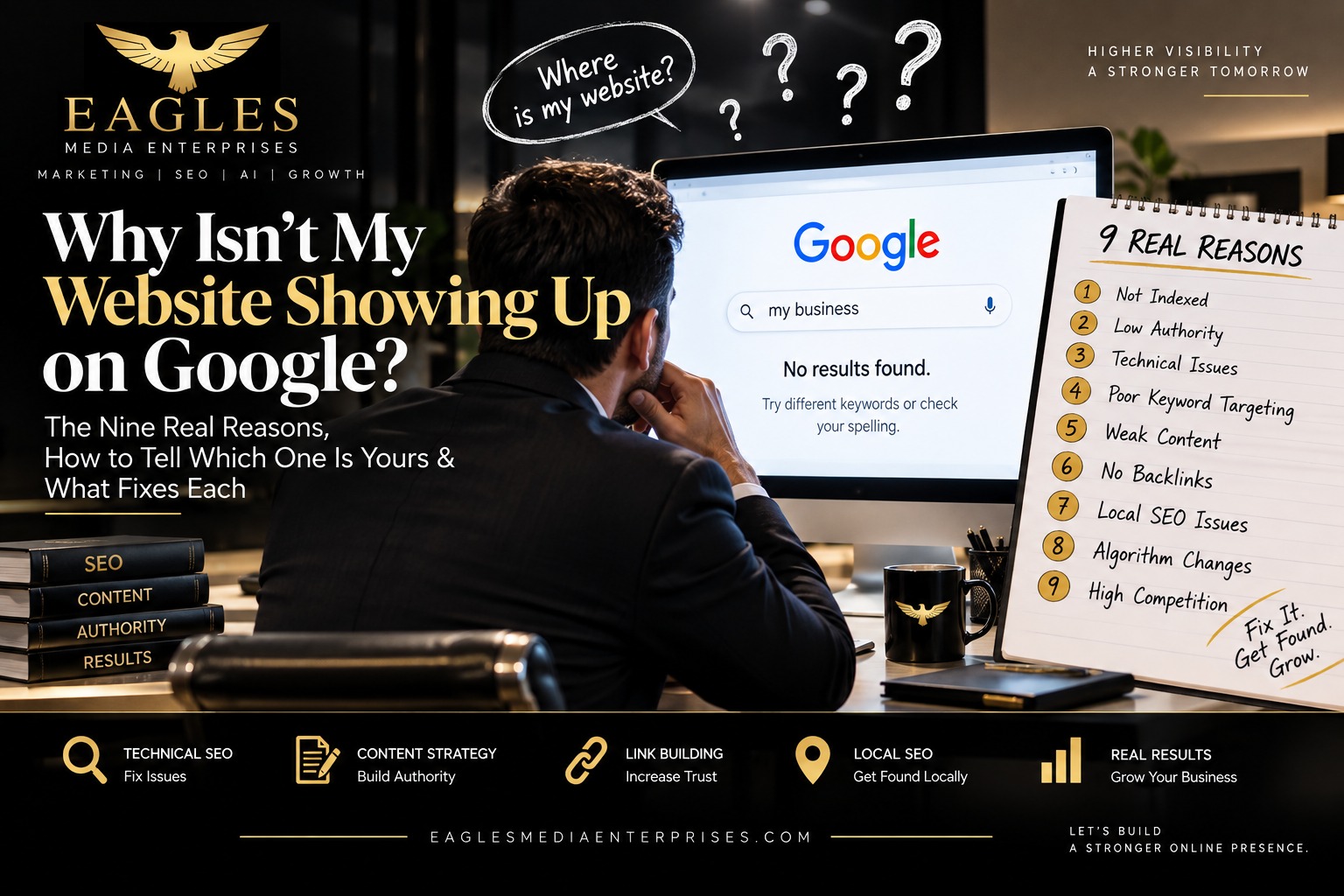
Why Isn’t My Website Showing Up on Google? The Nine Real Reasons, How to Tell Which One Is Yours & What Fixes Each
Written by Ibrahim Bazed, CEO of Eagles Media Enterprises
Every week a business owner calls our office with the same sentence: “I paid for a website and I can’t find it on Google.” Sometimes they typed their own company name and got a competitor. Sometimes they typed the service they sell and scrolled three pages without seeing themselves. Either way, the feeling is the same — you spent money, you have a real business, and the biggest directory in the world acts as if you don’t exist. Here is the honest diagnosis. There are nine reasons a website doesn’t show up on Google, they are easy to tell apart once you know what to look for, and every one of them has a fix. Some you can do tonight. Some need a professional. I’ll tell you which is which.
Quick Answer: A website that isn’t showing up on Google usually has one of nine problems: it hasn’t been indexed yet, it’s a brand-new domain with no history, the pages say almost nothing, it has no Google Business Profile so it’s missing from the map, it targets phrases nobody searches or that giants own, it’s technically blocked (a “noindex” tag, a robots file, a staging setting the developer forgot), it loads too slowly or breaks on phones, it has no links from anywhere, or it was hit by a penalty or a spam update. Check indexing first — type
site:yourdomain.cominto Google. If nothing comes back, that’s your answer. If pages do come back but never rank, keep reading. Eagles Media Enterprises will run the full diagnosis free: (708) 526-8484.
First, the 30-Second Test That Tells You Which Problem You Have
Open Google and search site:yourdomain.com (your actual domain, no spaces). One of three things happens. Nothing comes back: Google does not have your site at all — that’s an indexing or blocking problem (reasons 1, 6, and 9 below). A few pages come back but not all of them: Google found the site but decided parts of it aren’t worth keeping — thin content or technical issues (reasons 3, 6, 7). All your pages come back: Google has you; it just doesn’t rank you for what you sell — that’s a competition, authority, or Business Profile problem (reasons 2, 4, 5, 8). Now search your business name in quotes. If your own name doesn’t bring your site up first, you have a trust problem serious enough to call someone today.
Reason 1: Google Hasn’t Indexed It Yet
Google finds websites by following links and by reading a sitemap. A new site with no links pointing to it and no sitemap submitted can sit unseen for weeks. The fix: set up Google Search Console (free, takes ten minutes), submit your sitemap (on most WordPress sites it lives at yourdomain.com/sitemap_index.xml), and use the “Request Indexing” button on your home page and your main service pages. If your developer never set up Search Console, that alone tells you something about how the site was built. Our website maintenance services include this on day one.
Reason 2: It’s a New Domain With No History
Google treats a domain registered last month the way a bank treats a borrower with no credit file. The site can be perfectly built and still rank on page four for months because nothing on the internet vouches for it yet. The fix is not waiting — it’s building the file: a complete Google Business Profile, listings on the directories your industry uses, your chamber of commerce, your suppliers’ and partners’ websites, and content that gives people a reason to link. The timeline is real and I won’t pretend otherwise; the post on how long SEO takes to work lays it out month by month.
Reason 3: The Pages Don’t Say Enough
This is the most common reason I see in audits, and the one owners least expect. The site is beautiful; it is also four pages of eighty words each. “We are a family-owned roofing company committed to quality. Call today.” Google ranks pages that answer what a searcher wanted to know, and a page that says nothing can’t answer anything. The fix: one real page per service you sell, each one written the way you’d explain the job to a customer across the counter — what it includes, what it costs or what drives the cost, how long it takes, where you do it, what can go wrong, the questions people always ask. Our SEO content writing service exists because this is the fix that moves the most sites the fastest.
Reason 4: You Have No Google Business Profile — So You’re Missing From the Map
When someone searches “plumber near me” or “med spa Orland Park,” the top of the page is the map with three businesses. That map is not built from websites; it is built from Google Business Profiles. No profile, or an unclaimed one, or one with the wrong category, means you are invisible in the place most local customers look first — regardless of how good the website is. The fix: claim it, verify it, set the primary category to exactly what you are, add every service, add photos monthly, answer every review, and post to it. It is free, it is the fastest ranking win available to any local business, and it is what our Google Business Profile management service does every week for clients.
Reason 5: You’re Targeting the Wrong Words — or Words Giants Own
A one-location dental office is not going to rank nationally for “dentist,” and a home-services company is not going to outrank Home Depot for “water heater.” Owners often judge “not showing up” against a phrase they were never going to win, while the phrases they could win — “emergency dentist Tinley Park,” “tankless water heater installation Orland Park” — aren’t on the site anywhere. The fix is choosing the fights you can win: the service plus the place, the specific job, the question a customer actually asks. That decision is the beginning of every plan we build, and the local SEO vs. SEO post explains why local intent is the shortcut for most businesses.
Reason 6: Something Is Blocking Google (and Nobody Noticed)
A single checkbox in WordPress — “Discourage search engines from indexing this site” — is ticked by developers while a site is being built and forgotten when it goes live. A “noindex” tag left on the template, a robots.txt file that says “Disallow: /”, a password-protected staging setting, a broken redirect chain: any of them makes the site invisible with no error message anyone sees. The fix takes a professional fifteen minutes to find and five to correct, and Search Console reports it under “Pages — not indexed.” If your site was launched and never checked afterward, assume this until proven otherwise.
Reason 7: It’s Slow, Broken on Phones, or Unsafe
More than half of local searches happen on a phone. A site that takes eight seconds to load, shows a security warning because the certificate lapsed, or lays out wrong on a small screen gets demoted — and the customers who do arrive leave before it finishes loading. The fix: run Google’s PageSpeed Insights on your home page (free), fix the certificate today if it’s expired, and if the platform itself is the problem — an old builder, a bloated theme, a host that oversells servers — the honest answer is a rebuild on a fast foundation, which is what our website design and web hosting teams do together.
Reason 8: Nothing on the Internet Links to You
Google’s original idea, and still its strongest signal, is that a site other sites link to is a site worth showing. A business with a perfectly built website and zero links from anywhere else will lose to a worse website that the chamber, three suppliers, the local paper, and an industry association all link to. The fix is earning those links the legitimate way — memberships, partners, vendors, press, sponsorships, and content people cite — and never buying them from the emails that land in your inbox promising “50 backlinks for $99.” Those are the emails that lead to reason 9.
Reason 9: A Penalty or a Spam Update Took You Out
If the site used to show up and stopped, look at the date. Google runs spam and core updates several times a year (the most recent spam update finished in late August 2026), and sites built on bought links, hundreds of copy-paste city pages, spun articles, or hidden text lose rankings overnight. A manual penalty shows in Search Console under “Manual actions”; an algorithmic drop shows only as a traffic cliff on a date. The fix is removing what caused it — the purchased links, the duplicate pages, the thin auto-generated content — then rebuilding with real pages and real signals until the next update re-evaluates the site. It is recoverable. It is also slow, which is why we tell every client to never take the shortcut in the first place.
What You Can Do Tonight vs. What Needs a Professional
Tonight, yourself: the site: test; set up Search Console and submit the sitemap; claim and complete your Google Business Profile; run PageSpeed Insights; check for the “discourage search engines” box; renew an expired certificate. With a professional: finding hidden blocking issues, rewriting thin pages so they actually answer searches, choosing the right phrases to target, earning links, diagnosing and recovering from a penalty, and building the monthly rhythm that keeps a site rising instead of stalling. The two lists are not in competition. Do the first list, and you’ll have a clearer conversation with whoever you hire for the second.
How We Diagnose It — Free, in Writing
Send us the domain. Within two business days you get a written diagnosis in plain language: which of the nine reasons apply, what we’d fix first, what it costs, and how long it should take — no contract required to receive it. We have run that diagnosis for limousine companies, dental practices, med spas, contractors, manufacturers, wholesalers, and e-commerce stores across the country, and the record of what happened next is on our customer reviews page and in our limousine SEO case study, where organic rankings replaced a five-figure monthly ad spend. The full picture of what a campaign involves is in our SEO services page and the post on how much SEO costs monthly.
Questions Owners Ask When Their Site Isn’t Showing Up
How long does it take for a new website to appear on Google?
Days to a few weeks to be indexed once Search Console and a sitemap are in place; months to rank for competitive phrases. Indexing is a switch; ranking is a climb.
My site shows up for my business name but not for my services. Why?
That’s normal for a young or thin site: your name has no competition, your services do. The fix is content that targets the specific service and place, plus links and a strong Business Profile.
Can I just pay Google to show up?
You can run ads, and they stop the moment you stop paying. Organic rankings keep working — the SEO vs. PPC post is my honest comparison, and most clients end up with both, weighted toward organic over time.
My web designer says the site is “SEO-friendly.” Isn’t that enough?
“SEO-friendly” means the structure doesn’t get in the way. It doesn’t mean the pages have content worth ranking, links pointing at them, or a Business Profile behind them. It’s a foundation, not a campaign.
Is it too late if my site has been invisible for years?
No. Older domains recover faster than new ones once the real problem is fixed — age is an asset the moment the site starts giving Google something to rank.
You’re Not Invisible. You’re Undiagnosed.
A website that doesn’t show up on Google is not a verdict on your business; it is a symptom with a cause, and the cause is one of nine things. Eagles Media Enterprises will tell you which one, in writing, at no charge — call (708) 526-8484 or request the free diagnosis on our contact page. We are based in Orland Park, serve clients from coast to coast, and think like owners because we are owners. Let’s find out why Google can’t see you, and fix it.
About the author: Ibrahim Bazed is the CEO of Eagles Media Enterprises, a business-growth and SEO company in Orland Park, Illinois, serving clients nationwide. He works directly with business owners on the strategy behind their online growth.