
A Real Limousine SEO Case Study: How Organic SEO Services Replaced a $9K/Month Google Ads Budget
Three and a half years ago, a Milwaukee limousine company was spending roughly $9,000 to $10,000 every month on Google Ads during its heavy-spend periods because paid search was a major source of new business. Today, they are no longer spending money on Google Ads. The paid-search cost reached $0 because SEO grew strong enough to take over. Organic search now generates the visibility, traffic, calls, and bookings that the company once relied heavily on Google Ads to produce.
Quick Answer:
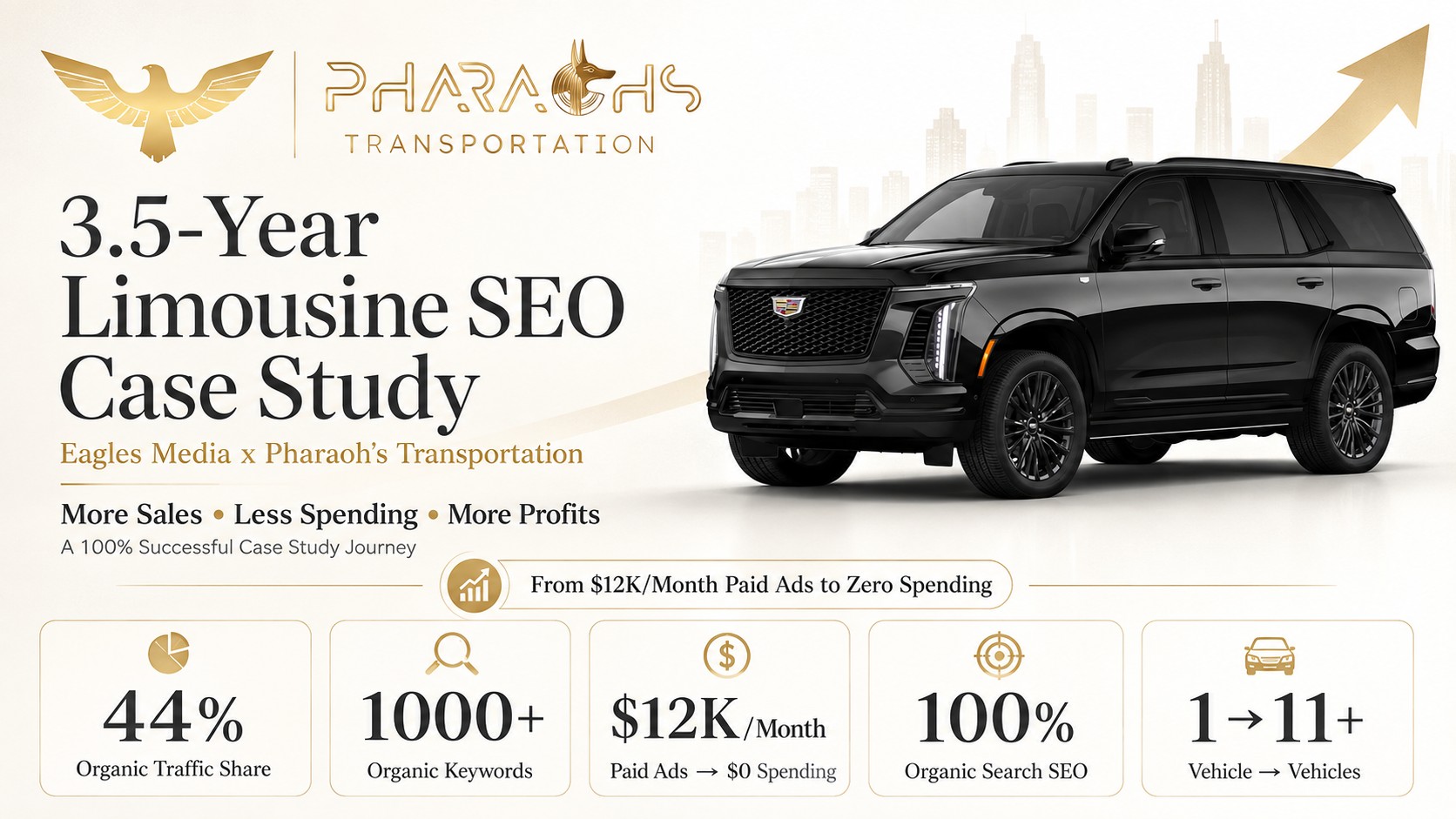
Pharaoh’s Transportation went from spending roughly $9,000–$10,000 per month on Google Ads during its high-spend periods to spending $0 on Google Ads after approximately 3.5 years of SEO with Eagles Media Enterprises. This was not simply a decision to stop advertising. SEO worked first, organic visibility grew, bookings increased, and that is what made it possible to stop depending on paid search. Third-party SEO data shows a 44% Traffic Share, an Authority Score of 29, 900+ ranking keywords, and expanding organic visibility, while the business grew from one vehicle to an 11–12 vehicle fleet.
Pharaoh’s once needed a large Google Ads budget to keep buying search visibility. Over time, SEO built rankings, authority, traffic, and organic bookings strong enough that the company no longer needed to keep paying roughly $9,000–$10,000 every month for Google Ads. The ads did not disappear first and SEO come later. SEO succeeded first — then the ad spend could go to $0.
What Changed Over 3.5 Years?
| Measure | Earlier Stage | Today, 3.5 Years Later |
|---|---|---|
| Google Ads Spend | Roughly $9K–$10K/month during heavy-spend periods | $0 after SEO became strong enough to replace the need for paid search |
| Search Traffic Engine | Heavily dependent on paid Google Ads | SEO and organic search — no Google Ads spend |
| Ranking Keywords | Building the organic search foundation | 900+ and still climbing |
| Bookings | 10–15 rides during difficult early stretches | $500–$5,000 owner-reported booking sales on stronger organic days |
| Fleet | 1 vehicle | 11–12 vehicles, with additional growth planned |
| Reach | Primarily local calls | Affiliate relationships extending across multiple states |
How SEO Took Google Ads From Nearly $10K a Month to $0
It is easy for a marketing company to say, “SEO reduced our client’s advertising costs.” That is why I wanted to show the actual billing history.
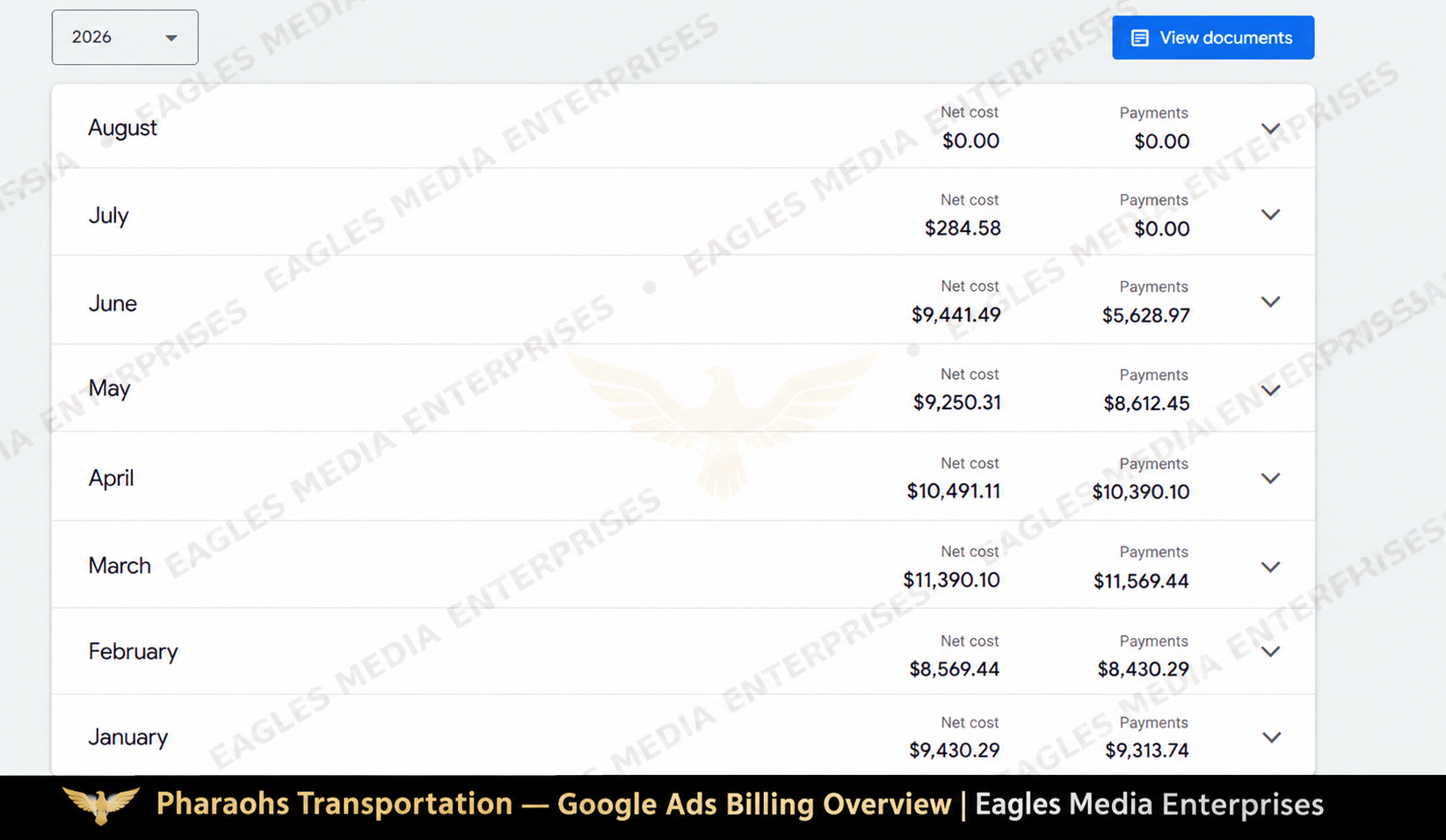
During the first six months of 2026, Pharaoh’s Transportation was still investing heavily in Google Ads. Net costs included $9,430.29 in January, $8,569.44 in February, $11,390.10 in March, $10,491.11 in April, $9,250.31 in May, and $9,441.49 in June.
Across those first six months, the average Google Ads net cost was approximately $9,762 per month.
Then the transition became visible in the billing itself. July dropped to only $284.58. August reached $0.00.
SEO did not merely lower the advertising budget — it eventually eliminated the company’s need to rely on Google Ads for search-driven customer acquisition. We did not shut the ads off first and hope SEO would work. Paid search stayed active while SEO matured underneath it. As organic rankings, visibility, traffic, authority, and bookings increased, the advertising budget could be reduced. Eventually, SEO had done enough of the job that Google Ads spending could reach $0.
That distinction is the entire point of this case study. They did not stop advertising and then hope organic traffic would appear. SEO grew first. SEO worked. Then the company no longer needed to keep buying the same level of visibility through Google Ads.
Where It Started: A Good Company Renting Its Search Traffic
When Pharaoh’s Transportation came to us, nothing was wrong with the business itself. The vehicles were immaculate, the chauffeurs were professionals, and the reviews were strong. What was wrong was the economics underneath it.
During the heavy advertising periods, roughly $9,000 to $10,000 a month was going to Google Ads, with individual months sometimes climbing above that range.
The advertising worked. That was exactly the problem. A major part of the company’s search visibility depended on continuing to pay for it. Pause the campaigns, and the company risked losing a major source of traffic and inquiries.
We wanted to change that relationship. Instead of paying Google month after month for each new piece of visibility, we wanted Pharaoh’s to build organic rankings it could continue benefiting from.
I have written elsewhere about the difference between SEO and PPC. Pharaoh’s was about to experience that difference in real life.
The Owner Factor: Why This Story Has a Hero, and It Isn’t Me
I want to say something most agencies will not, because it is one of the biggest variables in this case study: the client matters as much as the strategy.
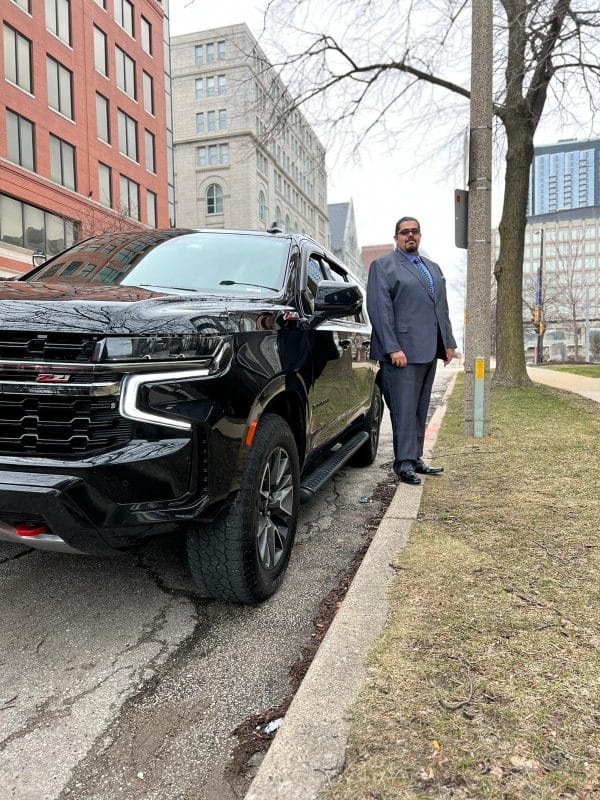
Khaled Aly founded Pharaoh’s in 2016 as an owner-operator — the kind of owner who knows the vehicles, the operation, and many regular customers personally. When we laid out the long-term SEO plan, he committed to it.
Through algorithm changes, slow seasons, expanding competition, and the months when organic results had not yet caught up with the vision, he stayed involved.
When we recommended joining credentialing organizations, he joined. When we said the company needed real photos and a stronger real-world presence, he delivered. When we said link building needed backing, he backed it. When we said social media and videos could help strengthen the brand, he showed up. When AI search arrived and we told him the playbook was changing again, his answer was essentially the same: do it right.
Somewhere in year one or two, almost every business owner becomes tempted by the cheaper option — another agency, a freelancer, somebody promising a faster road for less. Khaled remained committed to building the long-term foundation.
I have worked with hundreds of businesses. The companies that win long term tend to have one thing in common: the owner keeps showing up long enough for the work to compound.
From One Vehicle to a Fleet That Keeps Growing
Here is the measurement I love more than any ranking chart. When Khaled first walked into my office, Pharaoh’s ran one vehicle. One.
Today the fleet stands at approximately eleven to twelve vehicles — Sprinters and executive Jet Sprinters, Ford Transit executive vans, Escalades and Suburbans, S-Class and other luxury sedans — and the company continues looking at additional vehicles as customer demand changes.
Watch how the fleet grows, because it says something a ranking chart cannot. It grows around customer demand. If travelers repeatedly request a vehicle that is not currently in the garage, the company has an operational reason to consider adding it.
The Owner Who Answers His Own Phone
I also need to explain what the growth is actually made of, because SEO can bring customers to a company, but SEO cannot replace good service.
Khaled remains directly involved with customers. He deals with calls, texts, emails, dispatch, and the day-to-day operation. When another chauffeur takes a ride, the run is still being followed. Was the vehicle there on time? Is the traveler taken care of? Did the trip go correctly?
He hires chauffeurs and puts standards around who represents the company. The goal is to keep the environment safe, professional, dependable, and capable of handling everything from an executive account to a family airport transfer.
That is why repeat customers matter so much to this story. SEO can bring the customer in. The business has to earn the repeat booking.
SEO amplified what the business was already doing well. The marketing foundation and the operating standards had to grow together.
The First Year: SEO Was Not an Overnight Fix
Now let me tell you the part that makes this a real journey instead of a highlight reel.
The first four or five months were very tough. There were stretches when the company was not getting more than ten or fifteen rides. Khaled would come to my office and say it plainly: “We’re not getting a lot of rides.”
And I had to tell him the same truth I tell every SEO client: meaningful organic growth takes time.
So we made the practical decision to continue using Google Ads for immediate demand while SEO developed underneath it.
The ads could produce calls quickly. But every click had a price. A click might cost ten or twelve dollars, and sometimes an expensive click was simply a person asking for a price and leaving.
The first year was stressful, uncertain, and expensive. SEO had not yet reached the point where it could replace paid search.
Then organic search slowly started giving something back — a ranking here, an organic inquiry there, then a little more, then noticeably more.
Year Two: Google Ads Brought Immediate Business While SEO Kept Growing
Then the combined engine began to work: SEO building underneath and Google Ads producing immediate demand on top. The sales finally came. Some months were around $60,000, some around $70,000, and the client reported one month reaching approximately $95,000 in sales.
But strategy is not the only factor in revenue. Travel patterns, events, seasons, the economy, pricing, and customer behavior also matter.
Bad month. Good month. Bad month. Good month. The limousine industry naturally moves.
What mattered was the trend underneath those fluctuations: SEO kept getting stronger.
Then the Competition Got Harder
Just as the engine was finding its rhythm, the market became much more crowded.
Chicago chauffeurs increasingly crossed the border to handle Wisconsin work. Statewide operators competed for the same routes. Nationwide brands reached into the market. New transportation businesses continued appearing.
The practical result was simple: more businesses were competing for the same travelers and the same Google search results.
The calls came again. Why did this get harder? Why did a ranking move?
And the answer was also simple: competition does not stop because your SEO starts working. You have to continue strengthening the website, content, authority, brand, and trust.
Then the SEO Authority Started Climbing
The link building settled into place. The content stack matured. The website had more history. Trust signals accumulated. Work that had been completed over years started supporting other pieces of the campaign.
The Authority Score started moving: twenty-four. Then twenty-five. Twenty-six. Twenty-seven.
As the organic footprint grew, the type of opportunity coming into the company also broadened. The client reported affiliate interest from markets such as New York, New Jersey, Florida, Texas, and Los Angeles. Corporate inquiries, executive work, events, games, conventions, and partner opportunities became part of the larger picture.
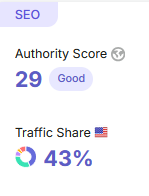
Third-party SEO snapshot showing an Authority Score of 29 and Traffic Share of 44% at the time of capture.
The Gap-Hunting Years: Building More Ways to Be Found Organically
This is where the working rhythm became a hunt for every legitimate gap in the search market.
Hotels? Study what travelers actually search.
Health and medical transportation intent? Research it.
Routes out of MKE? Look for missed demand.
O’Hare to Wisconsin and Wisconsin to O’Hare? Make sure travelers can find a useful answer.
Then came opportunities such as Lake Geneva, where travelers search for resorts, airport transportation, Sprinters, SUVs, black cars, group service, events, and weekend transportation.
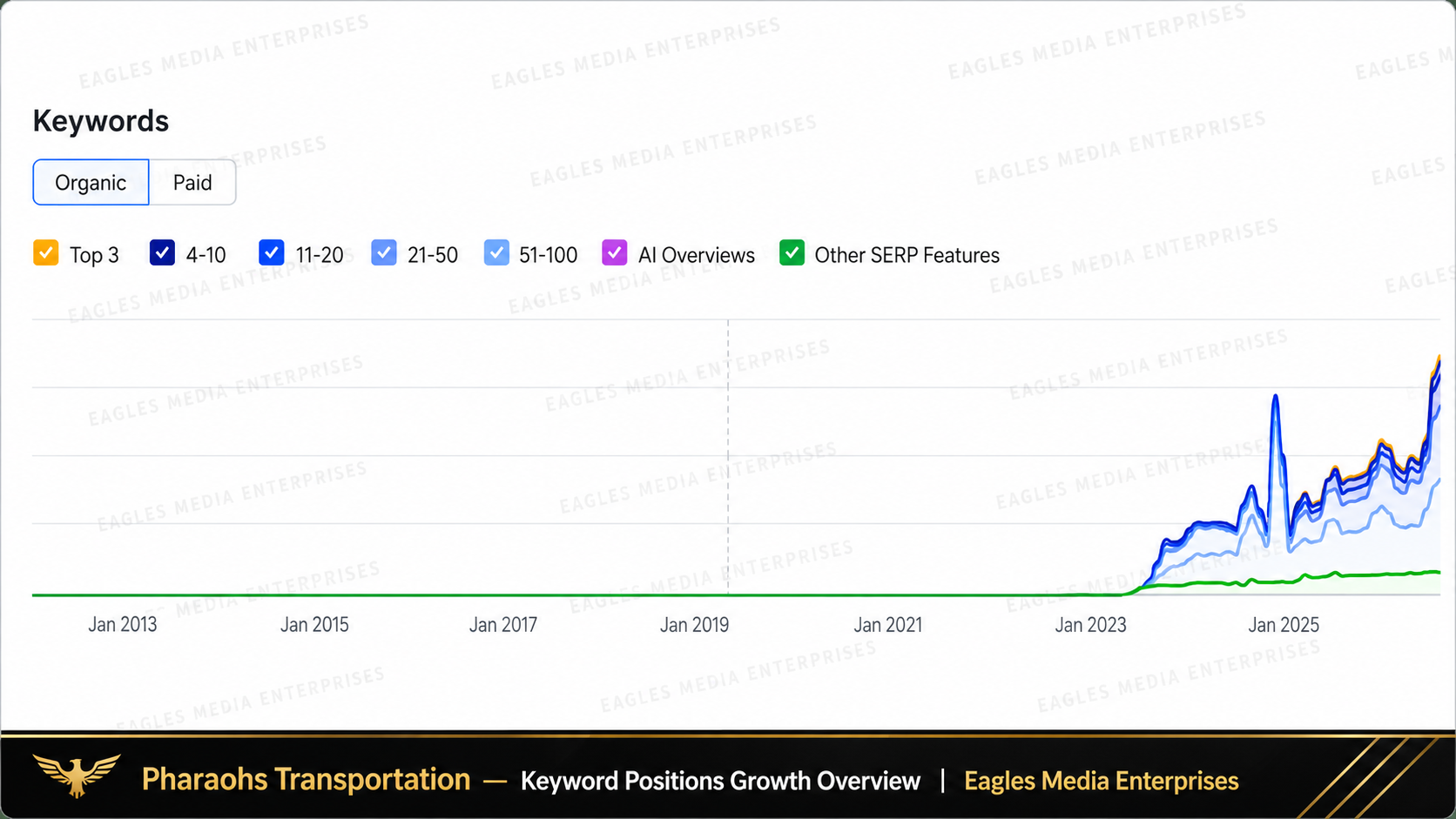
As the content footprint expanded, the range of searches and ranking positions expanded too. This is one of the clearest ways SEO gradually replaced the need to buy every visit through advertising.
SEO Was More Than Writing Blogs
There was no single trick responsible for the outcome. SEO worked because many parts of the company’s online presence were strengthened together over time.
Building SEO Without Cutting Corners
The long-term plan was not built around doorway pages, duplicate city pages, copied content, fake coverage, or shortcuts designed only to manipulate rankings.
Every page needed a reason to exist. We worked to avoid multiple pieces of content fighting for the exact same search intent.
At the same time, we strengthened proof outside the website: chamber presence, Better Business Bureau visibility, industry memberships, citations, TripAdvisor, local profiles, real photos, and third-party references.
One example is Pharaoh’s Metropolitan Milwaukee Association of Commerce listing.
SEO worked because we treated the company like a real brand, not a collection of pages built only for Google.
Why Replacing a $9K–$10K Ad Budget Actually Matters
A limousine and chauffeur operation carries serious overhead: commercial insurance, vehicle payments, chauffeur compensation, fuel, maintenance, detailing, technology, administrative expenses, and operating costs.
Wisconsin winters can also create slower periods while many of those expenses continue.
That is why eliminating the need for roughly $9,000–$10,000 every month in paid search matters so much.
When SEO can bring in the search traffic organically, money that once had to be sent to Google every month can stay inside the business or be used elsewhere.
The Turn: When SEO Took Over and Google Ads Went to $0
Then came the point this entire case study had been building toward.
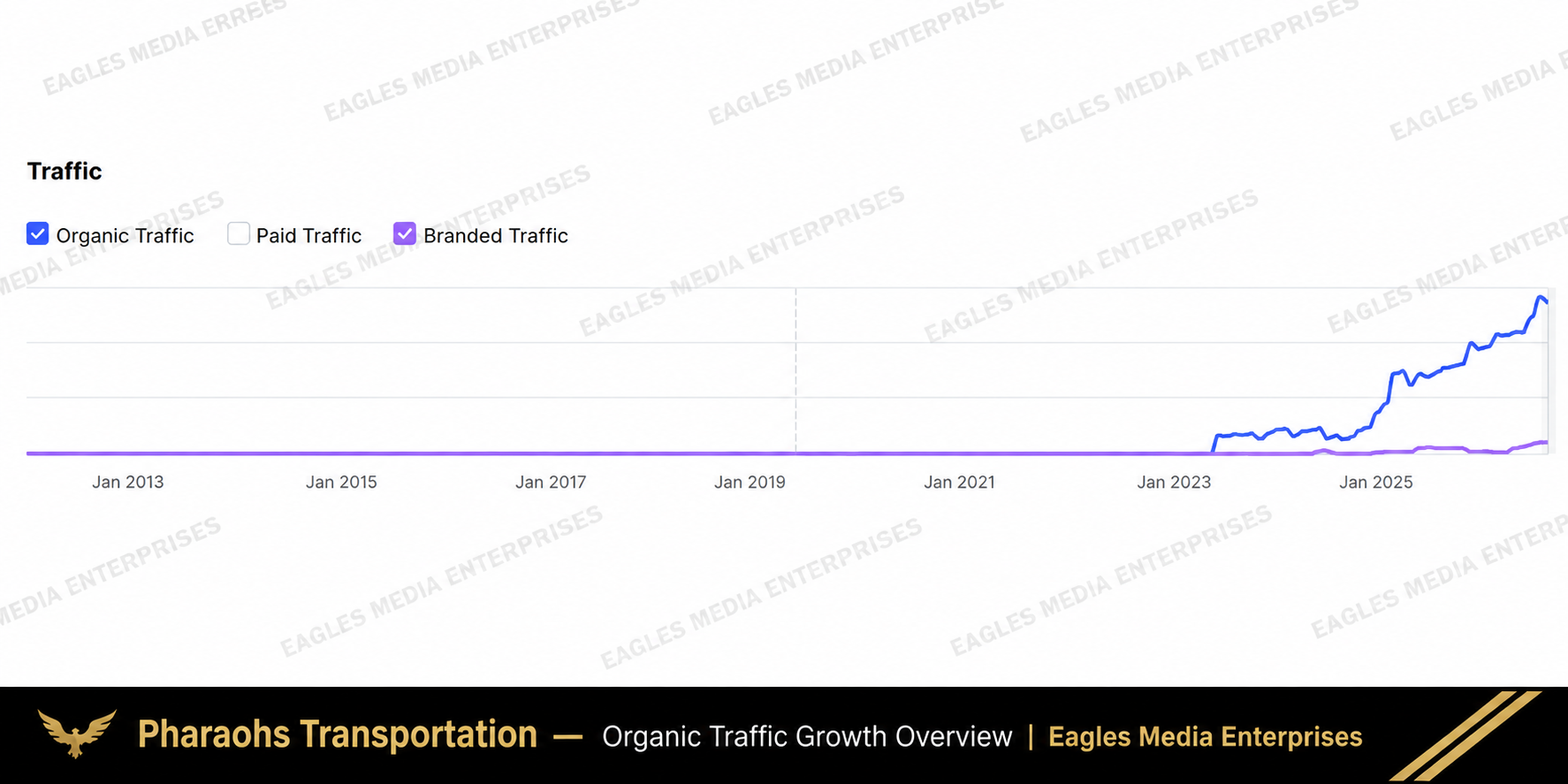
Organic rankings had become more established across valuable searches. Organic traffic had grown. The website covered more relevant customer searches. Authority had improved. Organic bookings were becoming a larger part of the business.
So we started reducing the Google Ads budget gradually while watching what happened.
The 2026 billing history shows the transition clearly: months near $9,000–$11,000 at the beginning of the year, $284.58 in July, and $0.00 in August.
At the same time, the third-party SEO picture showed a 44% Traffic Share, more than 900 ranking keywords, and an Authority Score of 29. The client reports that stronger organic days can produce approximately $500 to $5,000 in booking sales.
The company was no longer paying Google roughly $9,000–$10,000 every month for search visibility. Google Ads reached $0 because organic SEO had matured enough to take over the search-driven traffic and customer acquisition.
SEO Kept Evolving as Google and AI Search Changed
During this journey, search itself changed.
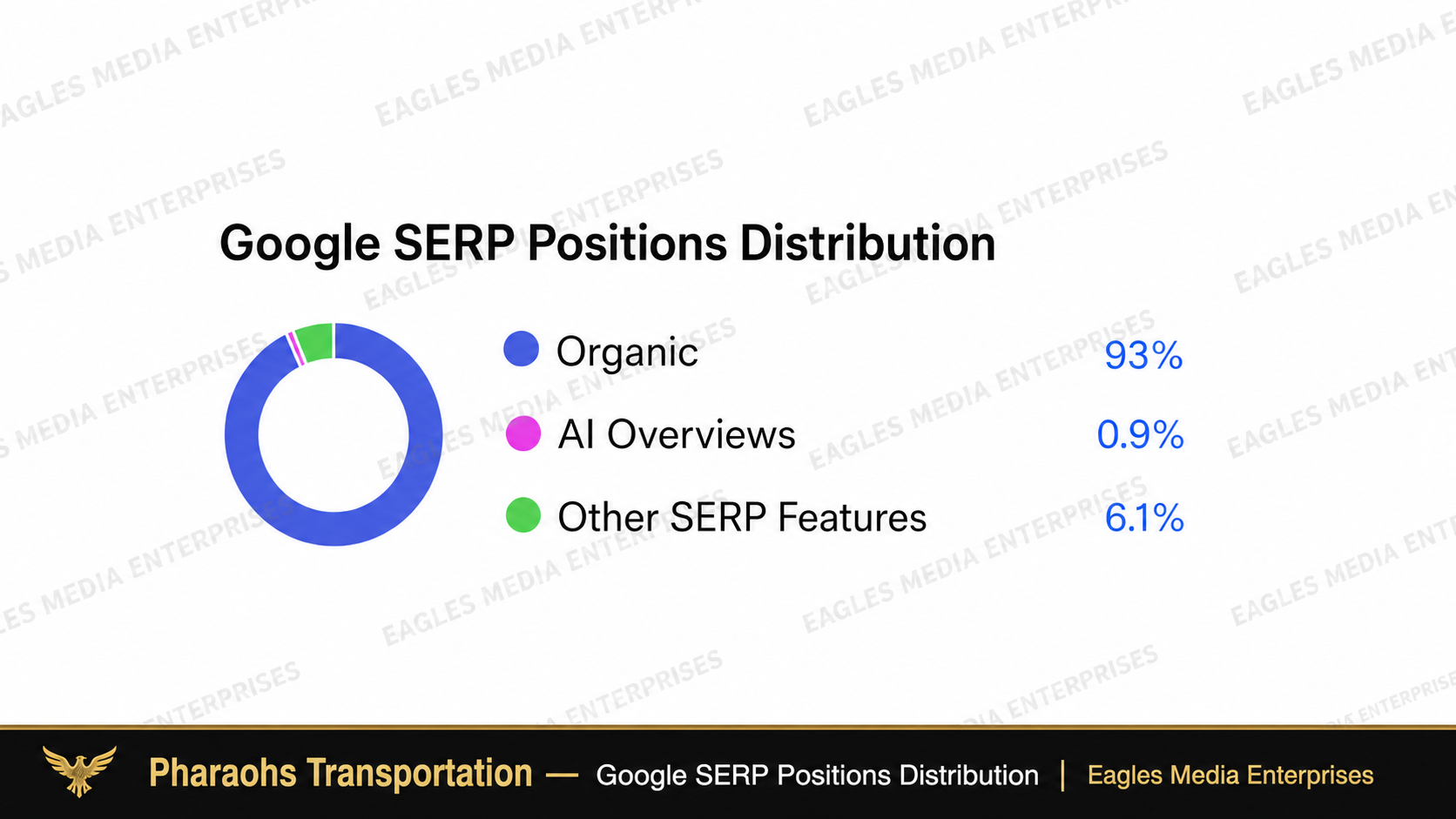
AI Overviews appeared. Answer engines grew. Generative search became part of how customers research businesses. People increasingly began asking ChatGPT and other assistants questions they previously typed directly into Google.
We did not treat this as a reason to abandon SEO. We treated it as an expansion of SEO.
We began working more deliberately on answer-engine optimization, generative-engine optimization, clearer questions and answers, entity consistency, AI-readable explanations, and content designed to answer actual customer questions.
The important lesson is simple: SEO works when it keeps evolving with search.
Where They Stand Today: SEO Instead of a Large Google Ads Budget
Three and a half years into this engagement, Pharaoh’s Transportation is not the same one-vehicle operation that once depended heavily on paid search.
It has grown into an 11–12 vehicle transportation company serving Wisconsin, with airport work, corporate transportation, long-distance service, events, affiliate work, luxury SUVs, sedans, Sprinters, and group transportation.
The website also has something it did not have at the beginning: years of organic search authority, broader ranking coverage, more content, more trust signals, more history, and more ways for customers to discover the company without clicking an advertisement.
That is what SEO changed. Google Ads once played a major role in buying new search traffic. Today, SEO is doing that job organically without a large monthly Google Ads bill.
Open for Partners: The Network Chapter
There is another chapter of this story that matters because it shows what can happen after a company builds enough operational capacity and brand recognition to serve more than its own direct customers.
Pharaoh’s now works with affiliate limousine companies and travel professionals who need Wisconsin transportation coverage.
Khaled has treated those relationships the way he treats the direct business: communication, standards, vehicles, chauffeurs, reliability, and long-term trust matter more than collecting one quick job.
The Invisible Seam: How Affiliate Travelers Get Treated
When an affiliate’s client rides with Pharaoh’s, the traveler should not feel a drop in standard simply because another company is fulfilling the trip.
The chauffeur is expected to arrive professionally presented. The vehicle should be detailed. The trip should be tracked. Pickup time matters. Communication matters.
Why? Because when another operator hands a traveler to a local affiliate, their own reputation is sitting in someone else’s vehicle.
If you operate a limousine company and need Wisconsin covered, Pharaoh’s has also published an affiliate limousine service guide.
The American Dream, the Long Way Around
What Khaled and his team have built is a version of the American small-business dream done the long way — ride by ride, customer by customer, year after year.
It was not one viral moment. It was not one lucky keyword. It was not one giant contract.
It was operating work combined with long-term marketing work: being available, protecting the customer experience, investing in vehicles, collecting reviews, building the website, building organic visibility, surviving slow periods, and continuing.
I am proud of the work our team did, but I am equally proud of the client for doing the other half of the job.
If you are traveling in Wisconsin or between Wisconsin and Chicago — including MKE, O’Hare, Midway, Madison, Racine, Green Bay, Lake Geneva, corporate transportation, airport transfers, SUVs, Sprinters, or long-distance service — Pharaoh’s Transportation is a company I am comfortable putting our agency’s name next to.
SEO Can Bring the Customer. The Business Has to Keep Them.
This is the other lesson inside the case study.
SEO can make a company easier to find. It can generate traffic, calls, forms, and bookings.
SEO cannot make a customer love bad service.
Treat a new customer well and that organic booking can become a repeat rider, referral, review, corporate relationship, or long-term account.
As traffic grew, we also worked on email outreach, staying visible between trips, and customer retention.
But the thing that truly retains a limousine customer is still the transportation itself: on time, clean, professional, responsive, and dependable.
The Difference Between Borrowed Business and Organic Demand
Many limousine operators begin by relying on personal relationships with other drivers and affiliates.
There is nothing wrong with legitimate affiliate work. The problem begins when another company’s relationships are the only source of demand you have.
When a traveler discovers your company through your own SEO presence, the relationship begins with your brand. They contact you. They can become your repeat customer.
That is another reason SEO matters: it helps a company build customer demand it actually owns.
To Every Business Owner Reading This: SEO Works, But Give It Time
The biggest lesson I want business owners to understand is simple.
Authority takes time. Trust takes time. Brand recognition takes time. Search engines need history and evidence.
You also have to continue adapting. Algorithms change. Search features change. AI search changes how people discover companies.
This campaign required research, content, technical improvements, links, reviews, strategy, local SEO, testing, corrections, and patience.
But the result at the end is easy to understand: a company that was spending roughly $9,000–$10,000 per month on Google Ads eventually reached $0 because SEO was bringing the search traffic organically.
Hire Anyone You Want — Just Make Sure They Know How to Build SEO
You do not have to hire us.
Hire the company you trust. Hire a competitor if they are the better fit.
What matters is that they understand search intent, your customers, your industry, technical SEO, content, authority, local SEO, and the long-term nature of the work.
Do not judge a multi-year SEO strategy like a 30-day advertising campaign.
Every useful page, earned link, review, citation, improvement, and month of history can become another layer in the organic foundation.
The Niche Test: Does Your SEO Company Understand Limousine Search Intent?
Transportation SEO is not the same as selling a generic product online.
The person working on your website should understand the difference between a black car SUV and a stretch limousine, an airport transfer and hourly chauffeur service, a prom booking and an executive roadshow, a convention account and an affiliate farm-out.
They should understand airport pickups, group transportation, executive Sprinters, vehicle capacity, corporate billing, luggage concerns, flight tracking, long-distance trips, and the language actual travelers use.
Because this is what matters:
That is search intent, and it is a major part of why SEO either works or fails.
Why Organic Rankings Are So Valuable
Every limousine and black car company wants visibility on Google.
The problem is that the first page has limited organic space.
Google Ads can place you in front of customers immediately when you pay for the campaign.
SEO takes longer because you are building relevance, authority, content, trust, history, links, reviews, and organic rankings.
But when SEO reaches maturity, the economics can change dramatically.
That is exactly what makes this Pharaoh’s case study so important.
Credit Where It’s Due: The Team Behind the SEO
Readers see screenshots and final results. They do not see the work behind them.
They do not see the search research, technical investigations, content mapping, internal linking, competitive analysis, local SEO work, authority building, and constant question: what are we still missing?
This growth story has the Eagles Media team’s fingerprints all over it.
I am proud of our team for the same reason I am proud of our client: both sides kept showing up.
A Thumbs Up, and a Promise
So here it is on the record: a full thumbs up to Pharaoh’s Transportation.
Khaled, thank you for the trust, the partnership, the conversations, the difficult months, the good months, and the willingness to keep building.
The company is still growing. The website is still growing. Search is still changing. There are still opportunities ahead.
Some clients are projects.
The Last Word: SEO Is Like Planting the Apple Tree
If I had to compress the journey into one idea, it would be this: SEO compounds.
You plant the tree, care for it, water it, protect it, and spend early seasons doing more work than harvesting fruit.
Eventually, if the work is done correctly and the business supports it, the tree begins producing.
That is what happened here.
The early stage required Google Ads and patience. The later stage had years of SEO work behind it.
The final proof is simple: Google Ads spending reached $0 because organic SEO had become strong enough to replace the need for that paid-search budget.
Questions Business Owners Ask About This SEO Case Study
These are the questions we hear most often after showing business owners how Pharaoh’s went from a large monthly Google Ads budget to organic SEO traffic.
What This Case Study Actually Proves
For anyone who wants the entire story in one simple statement, here it is:
Pharaoh’s Transportation went from spending roughly $9,000–$10,000 per month on Google Ads to spending $0 on Google Ads because SEO eventually took over the company’s search-driven customer acquisition. Over the 3.5-year engagement, organic visibility expanded to 900+ ranking keywords, an Authority Score of 29, and a 44% third-party SEO Traffic Share, while the business grew from one vehicle to an 11–12 vehicle fleet. The result was not simply lower ad spend. The result was a business that no longer needed to depend on paid search to be found.
That is why I published this case study.
Business owners ask whether SEO actually works or whether agencies simply say “give it more time.”
Here is one real example with the client, billing history, organic traffic growth, ranking growth, Authority Score, Traffic Share, and business growth behind it.
The result is not theoretical.
If you are currently dependent on paid advertising and wondering whether there is another way, this case study shows what can happen when SEO is built properly over time. You can also read my full breakdown of SEO versus PPC.
Why I Really Wrote This
I did not write this simply to ask for your business.
I wrote it because I want business owners to understand SEO in very simple terms.
Paid advertising can work quickly. SEO usually takes longer.
But paid advertising normally requires you to keep paying to keep receiving the traffic.
SEO builds an organic asset.
And when that organic asset becomes strong enough, it can change the economics of the company.
Today: $0.
Why? Because SEO works for them.
If you want a second opinion on your own website, Eagles Media Enterprises can study where your website stands, what competitors are doing, where the organic opportunities are, and what it would take to build a stronger SEO foundation.
Want SEO to Become a Bigger Part of Your Growth?
If your company depends heavily on paid advertising today, we can look at your organic visibility, search rankings, competitors, content, authority, technical SEO, and missed opportunities.
No overnight-ranking promise. No guarantee that every company will reproduce this exact case study. Just an honest look at whether SEO can become a stronger customer-acquisition asset for your business.
Case-study outcomes are specific to this client and are not guarantees of future performance. Revenue and booking figures are client-reported. SEO metrics shown are third-party measurements captured at specific points in time.