Every business owner with a marketing budget eventually asks the same question: rank for it, or pay for it? Here’s the answer from an agency that sells both — with the math nobody selling you one of them will show you.
Written by Ibrahim Bazed, CEO and Founder of Eagles Media Enterprises, senior marketing and SEO expert — running SEO and PPC campaigns side by side for limo companies, med spas, dental practices, contractors, and e-commerce brands across the USA. We profit either way you choose, which is exactly why I can afford to be honest about which one your business actually needs.
Quick Answer: PPC (pay-per-click advertising) buys traffic instantly and stops the moment you stop paying — it’s renting visibility. SEO (search engine optimization) takes roughly 3–6 months to gain traction and 2–3 years of sustained work and link building to reach maximum effect — but it compounds: the cost per lead falls every month the rankings hold, making it owned visibility rather than rented. The honest verdict from Eagles Media Enterprises, an agency that sells both: use PPC when you need leads this week, use SEO to make next year’s leads cheaper than this year’s, and sequence them together if the budget allows — ads carry the front end while rankings are built, then taper as organic takes over. In founder Ibrahim Bazed’s experience, SEO with GEO and AI optimization is the best long-term choice a business can make. Neither channel is universally “better” — one is speed, the other is equity.
In this guide: Side-by-side comparison · When PPC wins · The treadmill problem · My take: PPC is a bet · When SEO wins · The YMYL wall · The owner’s half of the job · The day the switch flipped · What SEO costs · Traffic share · The AI search wrinkle · Running both · Verdicts by business · A fish for everyone · Inside the limousine market · On competitors · FAQs · My bottom line
SEO vs. PPC: The Question Everyone Answers With Their Own Invoice
Ask a PPC agency and PPC wins. Ask an SEO shop and SEO wins. The comparison you actually need is the one written by someone with no reason to bend it — and because we run SEO campaigns and PPC advertising for the same clients, often in the same month, we watch this exact matchup play out in real dashboards all year. This guide is that comparison: what each channel really is, where each one honestly wins, the twelve-month math, and the verdict for your specific kind of business. Read it the way we’d give it to you across a table — no pitch, just the columns.
What You’re Actually Buying With Each One
PPC is an auction: you bid on a search like “emergency dentist near me,” your ad appears above everything the moment your card is charged, and you pay for every single click whether it becomes a customer or not. Turn the budget off and you vanish from the page in the same hour. SEO is construction: content, technical work, authority, and local signals built over months until Google ranks your pages on their own merit — the full mechanics are in our plain-English what is SEO guide. Clicks from those rankings cost you nothing per click, and the rankings keep working nights, weekends, and every day after the work is paid for. One channel is a meter running. The other is a machine you end up owning.
SEO vs. PPC Side by Side
| PPC | SEO | |
|---|---|---|
| First leads | Days | Typically 3–6 months |
| Cost model | Pay per click, every click, forever | Pay for the work; clicks are free |
| When you stop paying | Traffic stops same day | Rankings persist and keep producing |
| Cost per lead over time | Flat to rising (auctions get pricier) | Falls as rankings compound |
| Best at | Speed, testing, emergencies, precision targeting | Durable lead flow, trust, local map pack, AI search |
| Risk | Budget dependency — the treadmill | Patience — the ramp-up months |
When PPC Honestly Wins
Fair is fair — there are situations where telling you to wait six months for SEO would be malpractice. The new business that has budget to risk: no site authority, no reviews, no rankings — ads are the only way to be seen this month, and the leads fund the build (though as I explain below, a new business on thin capital should treat this one very differently). The emergency service: burst pipe, cracked tooth, dead furnace — when the customer needs someone in the next hour, the paid position at the top of the page earns its click cost. The offer test: before investing months ranking a page, a two-week ad campaign tells you whether anyone actually wants the thing — PPC is the cheapest market research that exists. The seasonal spike: prom season for a limo company, wedding season for a med spa — ads let you turn volume up precisely when the demand window opens. If that’s your situation, run the ads. And so nobody mistakes my honesty about the risk for a bias against the channel, here’s a winning bet from our own dashboards: a client campaign that turned 2,420 clicks into 276 conversions in a single month at $17.54 per conversion, on $4.84K of spend — roughly one conversion for every nine clicks, which in most service industries is money printing. That’s what PPC looks like when the industry fits, the targeting is tight, and the budget was scaled the way I describe below. The bet can absolutely be won — the point of this guide is knowing when the odds are yours. And keep reading, because the treadmill has a catch.
I’ll admit something too: it is genuinely hard sometimes to determine which path to choose. When you watch a campaign succeed like that one, the encouragement is real — the dashboard is green, the phone is ringing, and every instinct says pour more into the ads. I’ve felt that pull myself. But reality keeps returning me to the same place: SEO is the future strength and power of the company. Because here’s the question that success screenshot should raise, not settle — those 2,420 clicks cost $4.84K this month, and they’ll cost that again next month, and the month after. When your SEO reaches the level where it captures those same clicks organically, that entire ad budget comes home — month after month, permanently. The winning campaign is a good month; the rankings that replace it are a raise the company gives itself forever.
The Treadmill Problem: Why PPC Alone Gets More Expensive Every Year
Here’s what the ad platforms don’t put on the dashboard: auction prices only trend one direction. Every year more competitors bid on your keywords, and every year the same click costs more — so a business running PPC alone is running on a treadmill with the speed slowly rising. The current numbers make the point: per LocaliQ’s 2026 search advertising benchmarks, the average cost per click across industries now sits at $5.42 and the average cost per lead at $66.69 — with competitive service industries paying far more per click: legal services around $9.87, home improvement $8.33, dentists $8.00. Every one of those dollars is spent whether the click becomes a customer or a price shopper. Miss a month’s budget and lead flow doesn’t dip; it stops. We’ve watched businesses spend years and six figures on ads and end the run owning nothing — no rankings, no authority, no asset — while a competitor who invested the same money in SEO now outranks them for free on every search that matters. Rent is fine. Rent forever, at rising rates, with nothing to show when you stop — that’s the trap this comparison exists to flag.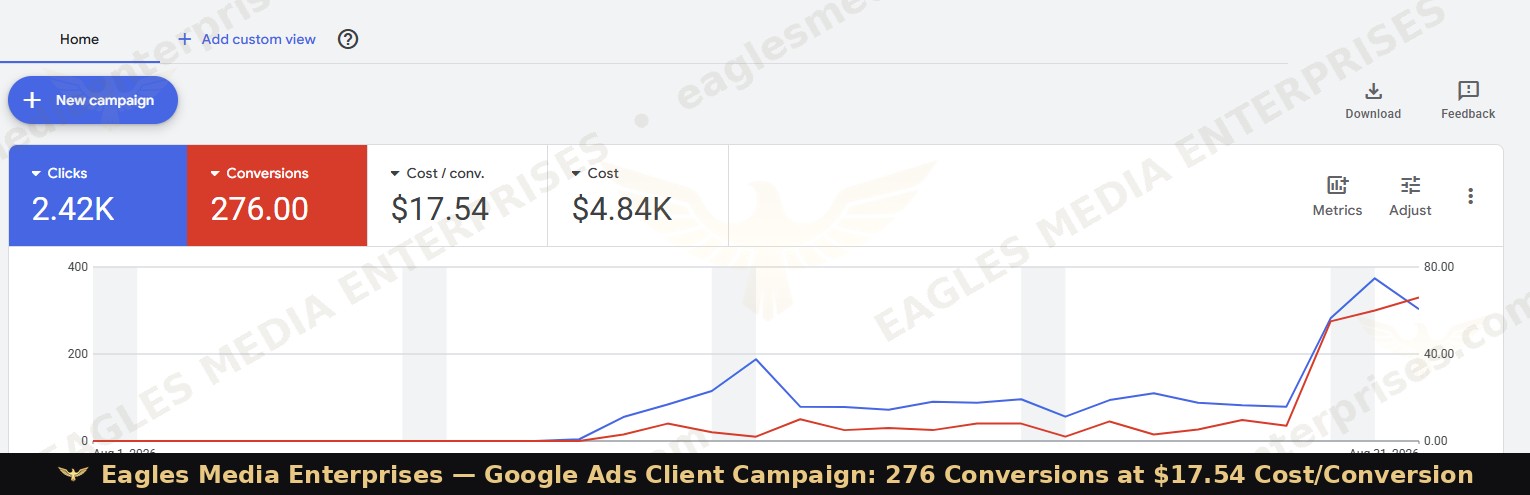
The Founder’s Take: PPC Is a Bet — You Control the Rank, Not the Caller
After years of managing ad budgets across industries, here is my honest take. Google Ads has its greatest days and its worst days — and you never know which one you bought. It is the greatest reach and the fastest way to the top of the page: most visible, most seen, most clicked. But here is what every business owner learns the expensive way: we can control the rank; we cannot control the person who calls. The same click that costs you real money can be a price shopper who asks one question and hangs up — that call is gone, and so is the budget behind it. Or it can be the best customer of your year. Sometimes luck lands and you close the biggest sale you’ve ever had off a single ad. That’s why I call PPC what it is: risk-taking. The risk carries the good and the bad, and the outcome belongs to customer behavior, not to your campaign settings.
What decides the odds of that bet? In my experience, five factors: the industry (emergency trades convert cold clicks; considered purchases leak them to price shopping), the coverage area (tight local targeting wastes less than broad reach), the budget (thin budgets can’t survive the bad days long enough to reach the good ones), the market demand (ads amplify demand that exists — they don’t create it), and the ticket price (a high-ticket business can absorb ten wasted clicks for one closed deal; a low-ticket business gets eaten by the same math). If you need fast sales, PPC can absolutely be the right bet — but if your ad happens to catch customers in price-shopping mode, the budget burns with nothing to show. Know which bet you’re placing before you place it. That judgment call — not the campaign setup — is where an experienced agency earns its fee.
And the range of outcomes is real, because I’ve lived all of them. I’ve watched limousine ad accounts sell $6,000-plus a day, day after day. I’ve watched accounts that only ever spent enough to return their own money — a break-even machine. I’ve seen budgets lost outright, and I’ve seen a single day close $45,000 in sales off the same channel. Same platform, same industry — completely different endings. And it’s the same story in every other industry we manage. That lived range is exactly why my standing advice never changes: start Google Ads on a lower budget for the first two weeks, read what the market actually sends back, then increase gradually. The low-budget opening costs you a little speed and buys you the one thing the platform never sells — information about your market before your money is committed to it. Scale what proves itself; kill what doesn’t. Nobody should learn their market’s behavior at full budget.
When SEO Wins — and Keeps Winning After the Invoice
The compounding math: SEO’s cost per lead is highest in month one and falls from there — the article ranking today produces leads next year at zero additional cost, which is why the businesses that dominate their local markets are almost always the ones that started SEO earliest. The trust factor: the click data here is not close — per First Page Sage’s 2026 CTR study, the #1 organic result takes 39.8% of clicks while the top paid ad takes about 2.1% — roughly nineteen times fewer — and the top three organic positions collect over two-thirds (68.7%) of all clicks on the page. Searchers trust the earned positions and skip the bought ones — positions no budget can buy, only earn (our local SEO guide covers the map-pack side, and Google Business Profile management is how you claim it). The durable moat: a competitor can copy your ad in an afternoon; they cannot copy three years of rankings, reviews, and authority. The honest timeline: yes, it takes months — our guide on how long SEO takes doesn’t sugarcoat it — but every month of that ramp is building something that stays on your balance sheet, not the platform’s.
And here I’ll correct the industry’s favorite number. SEO organic — with GEO and AI search on top of it — is the best choice a business can make. But the old line was always “give it six months,” and after living the reality across our accounts, I’ll tell you the truth the sales pages won’t: traction comes in months; maximum effect takes two to three years. The sites I’ve watched become genuinely busy — highest traffic, highest sales, the phone ringing on its own — got there on premium SEO plans sustained over years, with gradual, continuous investment in link building stacking more authority and more trust under the business the whole way. Six months buys you a seat at the table. Two to three years buys you the table. That’s not a pitch for patience — it’s the honest shape of the curve: SEO’s returns aren’t a line, they’re a snowball, and the businesses that dominate their markets are simply the ones that kept it rolling longest.
Which leads to the admission almost no SEO agency will print: SEO is not made for the low-budget company. Not because it doesn’t work — because it punishes anyone who has to quit partway up the climb. I’ve seen it turn to gold, but no less than two years in before you’re seeing the best of it. If a business can’t sustain the investment for that long, the honest answer is that it isn’t ready for SEO yet — and I’d rather say that up front than take a monthly fee from a company that will have to stop at month eight, right before the curve pays. The budget that funds fourteen months of SEO and then quits bought almost nothing; the same money held back until it could fund the full climb buys everything. Readiness, not enthusiasm, is the entry requirement.
The YMYL Wall: Why Google Doesn’t Trust New Companies Anymore
Now the part that will frustrate you, and the main issue I prepare every new client for. Google no longer extends easy trust to new companies, because of a standard called YMYL — “Your Money or Your Life.” Any business whose topic touches money, health, medical care, safety, or life decisions gets held to Google’s strictest trust bar — and that covers far more industries than owners expect: finance, medical clinics, dentists, med spas, legal, insurance, even transportation and home services where safety is on the line. A new site in a YMYL space will have a genuinely hard time earning traffic and rankings early, no matter how good the content is, because Google refuses to send people to businesses it cannot yet verify. Here’s what I’ve watched across our accounts: as the authority score climbs, the YMYL resistance drops. Every referring domain, every review, every verifiable trust signal chips at the wall — and the first two-plus years are exactly that: the heavy, unglamorous work of unlocking Google’s trust while improving the site the whole way.
Let me go deeper on the industries, because we work in the hardest ones daily. The “Your Life” half of YMYL covers every healthcare provider — medical spas, medical clinics, dental services — and it equally covers CBD online stores, smoke shops, and vape shops, because in all of these the consumer’s life and health can be at high risk, and Google’s search engine is built to protect the searcher first. That protection is why traffic is harder to earn in every YL industry, and it dictates exactly what the business must show. A medical clinic must display its staff, its licenses, its history, its credentials — visible proof that professionals are behind the practice. And the great unlock across all of them: real five-star reviews from happy customers and patients — nothing chips at the YL policy faster than a wall of genuine people saying they were treated well. Know also that the clock runs differently here: the verification of trust takes longer than it used to, and Google itself processes these industries more slowly. But once the evidence of professional service, expertise, and happy reviews accumulates, things start increasing with time as the domain authority builds — and the owners who understand the process and wait are the ones who collect the outcome.
And on timelines, the truth I tell every industry: many owners believe SEO maxes out at three or six months, but the reality differs from one business to another. Some industries respond faster — wholesalers, for example, can move quickly, as the $3.5-million story above showed. Others, especially the YL industries, respond slower by design. Both will see the growth — some just answer later than others. The bottom line: all of them grow, but patience and being on board are part of the success road map. Unfortunately, there are no shortcuts to Google search. Anyone selling you one is selling you the thing this whole guide exists to warn you about.
And part of that work happens off the website entirely. My standing advice to every client: sign up for the big credential institutions — they matter. The Better Business Bureau. Your local chamber of commerce. Every industry association your business qualifies for — the recognized bodies of your trade, whatever your field. Each one is a verifiable, third-party credential that says an outside institution checked this business and put its name next to it — exactly the kind of signal Google and AI search lean on when deciding whether a YMYL business deserves trust, and exactly what a new company lacks. It all comes down to the same thing in the end: elevating your business — showing more trust signals than the competitor next to you, on your site and everywhere your name appears. We practice this ourselves: Eagles Media Enterprises holds memberships in the National Limousine Association and the Illinois Limousine & Bus Association because we serve that industry — the credentials we tell clients to earn are the ones we carry.
And I’ll name the hardest challenge in this whole profession, because it isn’t the algorithm — it’s belief. The wall I hit most often is the client who doesn’t believe in investing in stronger backlinks: who hesitates on the chamber of commerce membership, who passes on the campaign to earn placements on the larger names — Forbes, Entrepreneur, being cited by Wikipedia, the well-known high-authority sites whose single mention outweighs a hundred small ones. I understand the hesitation; these links cost real effort and real money, and their value doesn’t show up on that month’s invoice. But authority is precisely what those links are made of — Google reads a business vouched for by recognized names completely differently than one vouched for by nobody — and in my experience the clients who fund that layer break through the YMYL wall noticeably faster, while the ones who refuse it do everything else right and still wonder why the needle moves slowly. If you take one sentence from this section: the strongest backlinks aren’t a luxury line on the proposal; they’re the bricks the wall actually comes down with. And when a client declines that layer, here’s what honestly happens: we’re left working the on-page side and the limited signals we can control — the content, the technical health, the local basics — and the challenge gets harder, because on-page alone doesn’t tear down a trust wall. It becomes a waiting game: time itself has to unlock the traffic, later, slowly, as age and small signals accumulate. The work still pays — but the client who wouldn’t fund the bricks shouldn’t be surprised the wall outlasted the ones who did.
During that building stage I’ve seen clients split into three groups. Some gave up partway. Some decided to stop SEO for life — convinced it doesn’t work, when the truth is they left before the wall came down. And some decided to stay and believe in the process. I can tell you exactly how that third group is doing now: they’re the happy ones. They reached their goals, they run no ads anymore, the business takes sales daily, and it’s still improving month over month. The bottom line I give every owner: SEO is the best choice for the one who has patience and is willing to wait — and the revenue doesn’t arrive as one jackpot, it improves gradually, then suddenly. The wall is real. So is the other side of it.
The Owner’s Half of the Job: Real Photos, Real Presence, Real Brand
There’s a part of this climb no agency can do for you, and I tell every owner plainly: you have to be active locally, and you have to show your real brand. Take the pictures. Shoot the live videos. Show the trucks, the storefront, the team at work, the finished jobs, the events you’re part of. A brand cannot grow out of no-show, no care, and no photos — and it cannot be faked with AI images either. Relying on AI-generated photos with unreal products and unreal people is a trap I now warn against constantly: Google knows very well what is AI and what is yours, and so do your customers. The real human photos are what elevate trust — and your customers genuinely want to see the real products, the real place, the real people they’re about to hand money to. So this one goes on the owner’s desk, not the agency’s: it is not an option, it is the right way to do it. The clients who feed us real photos and real footage every month give us raw material no competitor can copy — their Google Business Profile comes alive, their pages feel human, their brand becomes a place instead of a website. The ones who won’t lift a camera make everything harder: harder to rank, harder to trust, harder to succeed. The agency builds the machine; the owner has to show up in it.
The Day the Switch Flipped: What I Saw at Authority Score 24
Let me tell you about the moment SEO stopped being a theory for me and became the thing I build businesses around. I watched a client’s campaign grind through the slow months — content, technical work, link building, authority stacking one referring domain at a time — and when the site’s authority score crossed roughly 24 DA, everything changed at once. All the traffic lines turned upward together. Sales more than doubled in less than 30 days. And then the part that made me a believer for life: the client stopped their Google Ads completely — and the sales kept coming, daily, on organic alone. No budget running, no meter, no auction. The machine we’d spent the slow months building was simply doing its job, for free, every single day.
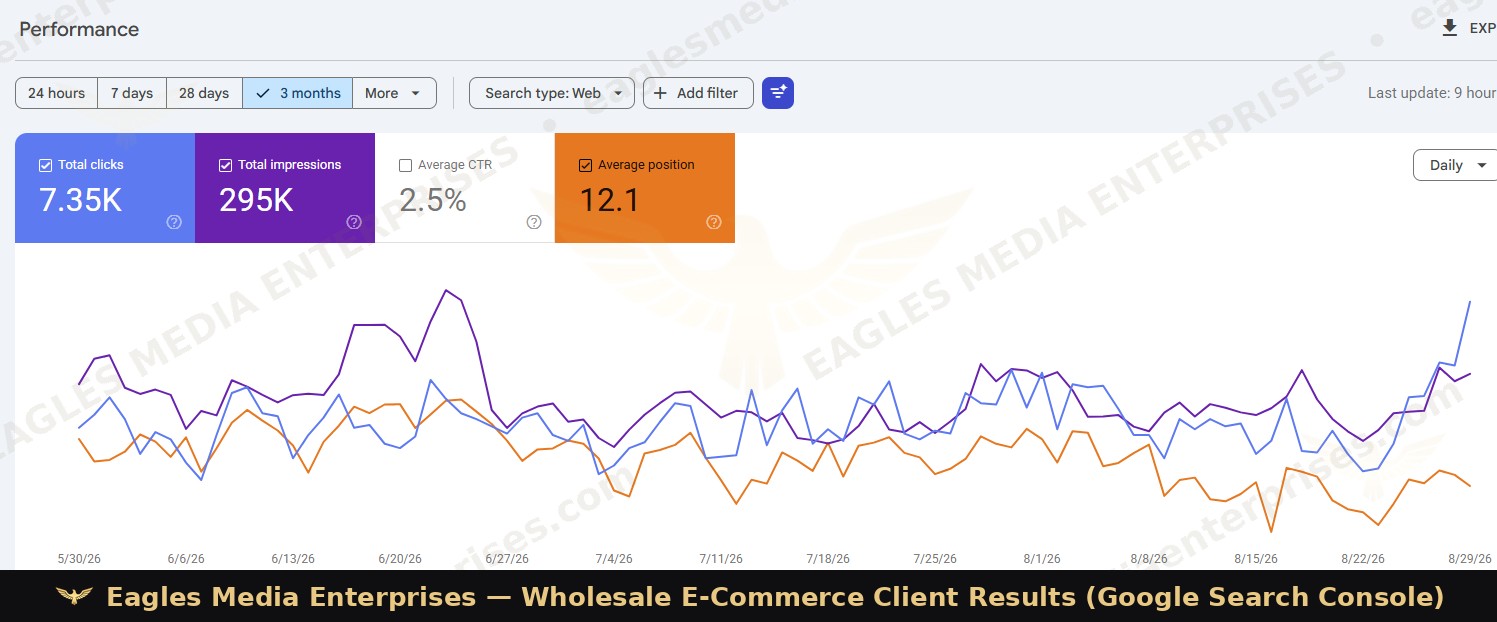
And if you’re wondering how high the ceiling goes, here’s the biggest number I’ve witnessed: a wholesale e-commerce company I worked with grew to over $3.5 million a month in sales — on 100% organic SEO. No ads carrying it. It took enormous work and dedication, and the owner was on board for all of it — every sales push, every season of the climb — and that business reached its goal and is still growing today. I share it not because every business ends there, but because it shows what the compounding actually compounds into when the work is done right and nobody quits: organic search isn’t a lead trickle, it’s an engine that can carry a company’s entire revenue.
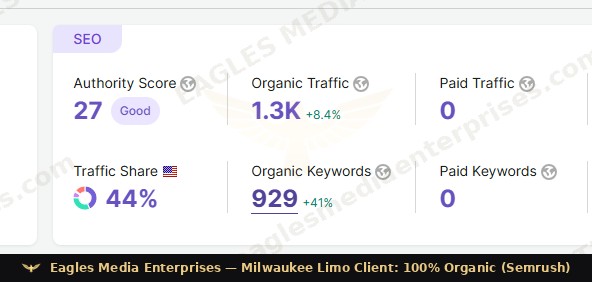
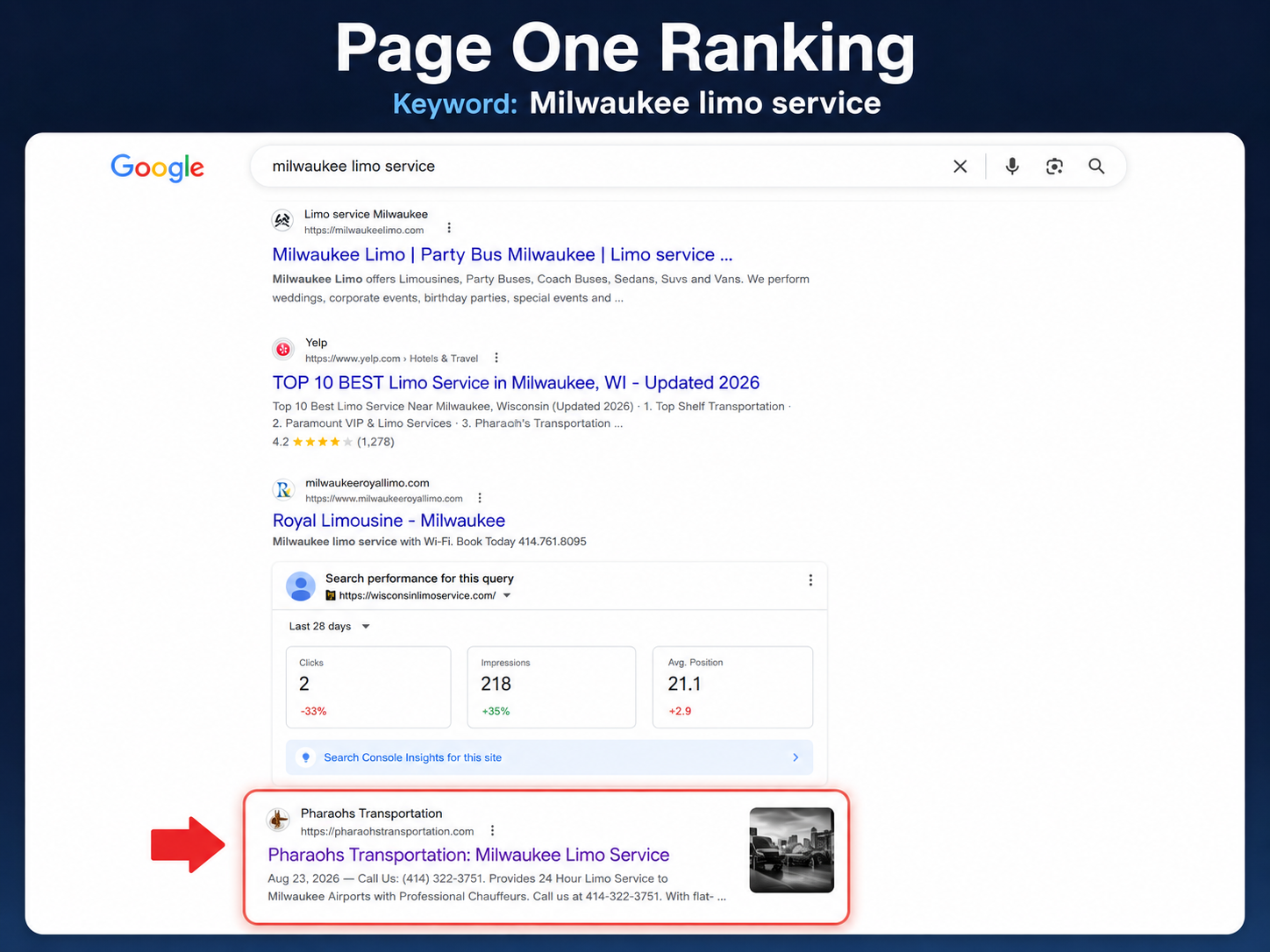
And it isn’t only e-commerce — here’s a live one from our own dashboards, in a service industry. A limousine client of ours runs on zero paid ads: no paid traffic, no paid keywords, nothing rented. Authority score 27 and rated “Good,” roughly 1.3K in monthly organic traffic and climbing, and 929 organic keywords — up 41%. Every bit of it is organic, and what matters more than the numbers is who’s behind them: mostly real travelers searching for limousine rides in Milwaukee and across Wisconsin — airport car service, events, corporate and executive travel, luxury chauffeured rides. That’s exactly the traffic a transportation company wants: people with a trip booked and a ride to arrange, arriving without a single click being bought. See it live — that client is Pharaoh’s Transportation, Milwaukee’s Milwaukee limo service, and their phone rings on searches we never paid a dollar to appear in.
That was the day I realized SEO is the real power — but only for the owner who will wait for it and stay precise enough to reach that level. There is no shortcut to the threshold; there is only the climb. And it’s why the advice I give every business owner since is the same: make SEO your main focus. Think high trust. Think authority. Think link building and organic traffic. That combination is more money coming in and fewer worries about paid ads going out — the difference between feeding a platform forever and owning an asset that feeds you. The businesses that hear this and commit are the ones whose phones ring on their own two years later. The ones that don’t are still bidding in the auction.
What SEO Actually Costs: The Tiers I Quote Every Week
I get this question constantly — “so how much does SEO cost?” — so here are the real tiers, because a business owner deserves to see the menu before the sales call. $750–$2,500/month is the small business tier: on-page work, local foundations, Google Business Profile, and steady content — right for a single-location business, priced within the range by market competition, with the honest caveat from earlier in this guide: fewer fronts worked means a longer climb. $2,500–$5,000/month is the mid-business growth tier — the industry’s median retainer of about $3,500 sits right in the middle of it — and the first level I consider properly funded for a competitive local market: the full-front work — content engine, AEO and GEO, the Google 3-pack, and real link building underway — the level where the two-to-three-year climb is actually being shortened instead of survived. And $5,000+/month is the enterprise tier — custom-quoted, because at this level the price follows the level of work, not a menu: owning a competitive metro market typically runs around $10,000/month with aggressive authority building, high-authority placements, and a content operation across every front — the fastest honest path to the switch-flip stage I described above — while national brands scale up from there based on markets, languages, and the sheer volume of fronts being worked. Since we’re comparing channels, here’s the paid side of the menu too: professional management of Google ads — local campaigns included — typically runs $1,000–$2,500/month, rising for national or enterprise accounts and for higher daily budgets, and understand what that number is: the management fee for the tuning, targeting, and scaling work, on top of the ad spend itself that goes to Google. That’s the fee that turns the gamble into a managed bet — and it’s also a recurring cost the organic side eventually retires. Two rules cut across every tier: you’re buying speed and fronts, not magic — the same wall comes down at every level, on different clocks — and the tier must match the market, because $1,500 pointed at a market where competitors spend $10,000 isn’t a budget, it’s a donation. The full breakdown lives in our guide on what SEO costs monthly.
Traffic Share: The Number That Tells You Who Owns the Market — and How to Unlock Yours
Notice one number in that limousine client’s results: 44% traffic share. Traffic share is the portion of your market’s search clicks that land on your site instead of your competitors’ — and to me it’s the truest scoreboard in SEO, because it doesn’t measure your traffic, it measures your traffic against everyone fighting you for it. Nearly half the market’s organic attention flowing to one operator, with zero paid ads, is what market ownership looks like. And unlocking it comes down to one word Google’s systems are built around: trust rate. Google’s bots have to see your company as a legitimate, credited business before they hand you a market’s traffic — and that verdict is assembled from signals you control.
Here’s the unlock list I hold every client to. Real reviews — earned from real customers, never purchased, never faked; one exposed fake burns more trust than fifty real ones build. Compliance — follow the laws, regulations, and guidelines of your industry visibly: licenses shown, rules respected, safety standards published. Safety and guides — publish content that protects and educates your customers, because a business that teaches reads as a business that cares. Transparency with customers — real prices, real policies, real answers, nothing hidden behind a phone call that could have been on the page. The legal pages, kept and kept current — terms and conditions, privacy policy, refund and cancellation policies where they apply: Google’s bots check for them, customers check for them, and a business missing them looks like a business planning to disappear. And understand this one clearly, because it’s a gate, not a suggestion: Google will not unlock a market’s traffic share to a business without a clear privacy policy — one that states plainly that you do not sell your customers’ private information and that their data is safe with you. Remember who Google actually works for: the visitor. It cares a lot about the people it sends to your site, and safety matters to it more than almost anything — so a business that visibly protects its visitors gets handed more of them, and a business that’s vague about privacy stays invisible no matter how good its content is. These pages aren’t decoration; they’re the paperwork of legitimacy, reviewed and updated as your services and the regulations change. And the About Us page must be right and real — this one matters far more for trust than most owners believe. Real history, real goals: the story of how the business started, the CEO and founders by name, the team behind the work. Google’s systems and AI search are both trying to answer one question about you — is there a real, accountable business here? — and a true About page with real people and a real beginning answers it, while a page of vague “we are passionate about excellence” filler answers nothing. Write the history as it happened, name who’s responsible, state where you’re going, and add the team if you can: every real detail on that page is a trust signal, and every generic sentence is a wasted one. And the one almost everyone fails: alignment of every detail on every page. If you say 10 years of experience, it must say 10 years on every page that mentions it — not 12 in one footer and “over a decade” in another. Your address, identical everywhere. Your phone number, identical everywhere. Your review count, consistent everywhere it appears. Google’s bots cross-check these details across your site, your Google Business Profile, and every directory that lists you — and every mismatch is a small vote that this business isn’t careful with the truth. Align it all, keep it aligned, and the trust rate climbs; let it drift, and you’re leaking authority from a hundred tiny holes while wondering why the traffic share won’t move.
Why I Tell Every Client to Take the Premium Package — and It’s Not an Upsell
Here’s my honest position on packages, and I know how it sounds coming from an agency owner — but the math backs it. Search is no longer one front; it’s five. You need the classic SEO work for organic rankings. You need AEO and GEO so AI assistants and answer engines mention your business. You need the Google 3-pack — the map results where local customers actually pick — which is its own discipline of profile management, reviews, and local signals. You need social media feeding brand signals under all of it. And more keeps arriving every year. A premium plan works all of those fronts at once, which is what the climb actually requires. A basic plan isn’t wrong — it’s slow: it covers one or two fronts, so the same wall takes longer to come down, and the business pays for more months to reach the same threshold. Basic doesn’t cost less; it takes longer. If the budget forces basic, take basic and be patient — but if the goal is reaching the switch-flip stage, the full-front premium approach is the shortest honest path there. That’s not a sales line; it’s why our own service stack is built to cover every front under one roof.
The Twelve-Month Picture: Same Budget, Two Different Endings
Put the same monthly budget into each channel and watch the year unfold. The PPC-only business gets leads in week one — and in month twelve it’s paying the same or more per lead, holding an asset worth exactly zero the day the card declines. The SEO-only business eats lean early months — and finishes the year with rankings producing leads whose marginal cost is trending toward free, plus an asset that keeps producing in year two without the year-two budget. That’s the whole comparison in one sentence: PPC’s best month is its first; SEO’s best month is always ahead of it. The real numbers for your market depend on your industry’s click prices and competition — the tier pricing above shows what the SEO side runs monthly, and we’ll quote your PPC side from your actual keywords, not averages.
The AI Search Wrinkle Nobody’s Ad Budget Can Fix
There’s a new column in this comparison that didn’t exist a few years ago. When a customer asks ChatGPT or Google’s AI Overviews “who’s the best med spa near me” or “what does a limo to O’Hare cost,” the AI assembles its answer from content, authority, and entity signals — the raw material SEO builds — and there is no ad unit that buys your way into that answer. Businesses invisible to AI search are invisible to a growing share of their customers, and the only path in is the organic one: structured content, real expertise, consistent entity signals. It’s why we build answer engine optimization and generative engine optimization (GEO) into every SEO campaign we run — and why the “SEO vs. PPC” question tilts a little more toward SEO every year the AI answers grow. The full picture is in our AEO guide for 2026.
The Sequencing Play: How Smart Budgets Run Both
The best-performing accounts we manage don’t pick a side — they sequence. Months 1–3: PPC carries lead flow while the SEO foundation is built; the ad data doubles as keyword research, showing exactly which searches produce buyers before a single article is written. Months 4–8: rankings start landing; ads narrow to the highest-intent, highest-value keywords while organic absorbs the rest. Month 9 onward: SEO carries the volume, PPC holds only the auctions worth paying for — emergencies, top competitors’ brand gaps, seasonal pushes — and the blended cost per lead drops below what either channel produces alone. Paying for clicks you could rank for is waste; waiting six months with zero leads is pain. The sequence eliminates both.
Verdicts by Business: Find Yours
The brand-new business with limited investment: careful with PPC — this is our founder’s firmest advice. A new business with thin capital is the player least able to absorb the bad days of the bet, so avoid leading with ads, or run them only at a deliberately low budget and scale with time as the returns prove out, while SEO starts the same month building what you’ll own. The established business with reviews and history: SEO first — you have the authority to rank faster than a new site, and you’re likely overpaying for clicks you could own. The emergency-driven trade (dentist, HVAC, plumber): both permanently — ads for the 2 a.m. emergency, SEO for the map pack where most customers pick. The med spa or elective practice: SEO-led — these customers research for weeks before booking, and research-phase visibility is organic territory. E-commerce: both — shopping ads for buyers, SEO for the product and guide searches that build the brand. The tight budget that can’t yet fund either properly: here’s the truth both industries hide — a thin budget is punished by both channels. PPC at low spend is a bet you can’t afford to lose repeatedly, and SEO demands sustained investment for two-plus years before its best returns arrive. My honest ladder: start with a small, carefully scaled ad budget and your free foundations — Google Business Profile, reviews, a clean site — build revenue, and step into SEO only when you can fund the full climb. Our guide on whether SEO is worth it for small businesses gives that decision the honest treatment.
The Market Has a Fish for Everyone: My Word to the Struggling Business
Before the questions, one thing I want every discouraged owner to hear, because I say it across the table constantly. Look at the market itself: the customers are out there, and they are increasing — more people search online for what you sell every year than the year before, in nearly every industry. The USA market is flooded with customers. There is a fish for everyone. The businesses that struggle usually aren’t short on demand; they’re invisible to it. So my input, plainly: if your business is struggling, you must start your online growth strategy — and believe in it, and in the impact it can bring. I believe today that the slow business can be fixed and improved. Keep the traditional marketing you believe in — the print, the signs, all the old school; it won’t hurt to keep it all. But understand what the modern stack — SEO, AEO, GEO, AI mentions — is capable of: done right, with the effort and the work sustained, I’ve watched it increase business revenue 2,000% and higher — the wholesale company earlier in this guide went from a standstill to $3.5 million a month, which is far beyond that number. Dreams and hopes become reality when you work hard toward them. The path is never easy — but for the owner who does the work right and stays on it, the success is certain.
Inside the Limousine Market: What a Truly Competitive Industry Looks Like
Since we serve it every day, let me show you what real competition looks like through the limousine and black car industry — because it’s one of the toughest SEO markets in local services, and growing a limo brand takes longer for reasons every owner should understand before they start. Take the Chicago market: per the 2025 statistics, there are about 13,000 licensed chauffeurs, and all of them are focused on the same 50 miles — the same two major airports, O’Hare and Midway, and the same daily rides to downtown Chicago. Summer is a great season for the limousine business, but the big fish and the small fish are still swimming in the same water. The larger companies run heavy SEO with heavier results, they already dominate the market, and they sit on top of the rankings for the keyword everyone wants: Chicago limo service. New companies come in believing they can take over the market in a year or two — but the reality is that the big fish just keeps getting bigger while the smaller company fights for a piece of the market. We’ve succeeded in that fight ourselves: our client Royal Limo Services ranks on page one for that exact keyword — and even with that win on the board, I’ll tell you the market remains a big challenge to go through.
And the failures in this industry are instructive, because most of them aren’t SEO failures. Thousands of limousine companies fail from poor financial management — the classic mistake is buying a larger fleet before the load of orders comes through. Excitement can hurt your growth planning. On the marketing side, most limo companies hire freelancers and rely on cheaper offshore options — and this is where Google’s evaluation quietly decides the race, because Google chooses the right content, and USA local SEO companies win this battle on quality. It’s not patriotism; it’s knowledge. A local team understands limousine terminology and services — the difference between a black car transfer, an hourly charter, and an airport pickup — and chooses the right vehicles and the right photos. The offshore freelancer too often thinks the word “limousine” means a stretch limousine only, and posts photos of a stretch from 1999 or older on a luxury brand’s website. That one photo tells every visitor and every algorithm the company doesn’t know its own industry. This is why I say choose quality over cost — in a market this tight, the content’s accuracy is part of the product.
The good news for this industry: it has specialists. Limousine SEO is our home turf at Eagles Media Enterprises — we manage almost 25–30 limousine companies on a monthly basis, and here’s the part I’m proudest of: we grow mostly from referrals. Our clients send us their colleagues. In an industry this competitive, operators recommending their own SEO company to other operators is the loudest review that exists — it shows they’re happy, and no marketing claim of mine could say it better. But even with a specialist on your side, it all comes back to the same principles this guide keeps landing on: patience, waiting for the growth, and following the strategy and the roadmap planned for every year — so each year is better than the last.
The honest challenge for SEO companies like ours is convincing limousine owners of the right path — because owners can lose patience fast when they discover the market is tougher than they thought. So here is my input, from years inside this exact industry: the market is for everyone, but it is mostly for the ones who keep pushing. The consistent ones. The ones who believe in their brand and are willing to give SEO its time and its growth — no pressure, no panic, no fleet bought on excitement. I’ve seen the before and the after in this industry with my own eyes — and the ones who stayed are the ones who gained the success later. In the hardest markets, patience isn’t just a virtue; it’s the strategy.
On Competitors: They’ll Always Be There — Here’s How to Win Anyway
Let’s talk about competitors honestly, because every owner asks. They will always be there. Some won’t bother you at all. And some will play the dirty games — clicking your ads to waste your PPC budget (one more risk the paid column carries that the organic column doesn’t), copying your prices the day you publish them, or competing with you right out in the open. My advice after years of watching this: the best response is to ignore them and focus on your relationships with your clients and customers. Stay solid with the best customer service and care you can deliver. Keep the trust level high. Put your energy into getting more reviews and better ratings, and get your business listed on the top-rated listing companies for your industry — every legitimate listing is a trust signal working for you while your competitor is busy watching you. And if you’re thinking about the future and revenue, think about one number: your authority score should be increasing — because as this whole guide has shown, that’s what unlocks the traffic that generates the revenue. Keep the focus on you. When a competitor does something well, don’t resent it — learn the best from them and turn it into revenue. Improve your services, scale up, and let them chase you. The market rewards the business that got better, not the one that watched.
SEO vs. PPC: Most-Asked Questions
Is SEO better than PPC?
For speed, PPC wins; for growth, SEO wins — and in the experience of Eagles Media Enterprises founder Ibrahim Bazed, SEO is the best solution for long-term growth, one hundred percent, over PPC. PPC delivers leads in days and stops when spending stops; SEO compounds, with cost per lead falling as rankings hold. Timelines vary with competition, industry, location, and demand — be wary of flat 3–6 month promises.
Should I do SEO and PPC at the same time?
If the budget allows, yes — it’s the highest-performing setup we manage. Ads carry lead flow while rankings build, ad data sharpens the SEO keyword targets, and paid spend tapers as organic takes over the volume.
Which is cheaper, SEO or PPC?
Over the first 90 days, PPC usually produces cheaper leads. Over 12–24 months, SEO almost always wins — ad auctions get more expensive every year while ranked content produces leads at no additional cost per click.
Can I stop running ads once SEO starts working?
You can taper rather than stop: keep paid coverage on emergency and high-value searches where the top ad position earns its cost, and let organic rankings absorb everything else. Most of our mature accounts run a fraction of their original ad spend.
Does running PPC improve SEO rankings?
Not directly — Google doesn’t rank you higher for buying ads. Indirectly, yes: ad data reveals which keywords convert, ad traffic can earn reviews and brand searches, and both feed the SEO strategy.
How long does SEO take compared to PPC?
PPC produces traffic within days of launch. SEO typically shows early movement in 2–3 months and meaningful lead flow in 3–6 — but in my experience across hundreds of campaigns, the maximum effect — the highest-traffic, highest-sales stage — takes 2–3 years of sustained premium SEO with gradual link building compounding authority and trust the entire way.
How much does SEO cost per month?
Real-world tiers run from $750–$2,500/month for small business local campaigns, $2,500–$5,000/month for mid-business full-front growth campaigns (the industry’s ~$3,500 median sits in this range), and $5,000+/month at the enterprise tier — custom-priced on the level of work, with competitive-metro domination campaigns typically around $10,000/month and national brands scaling from there. Google ads management typically adds $1,000–$2,500/month on top of ad spend (higher for national accounts or large daily budgets). Every tier buys the same climb at a different speed, and the tier must match the market’s competition.
What is traffic share in SEO and how do I increase it?
Traffic share is the percentage of your market’s organic search clicks that land on your site instead of competitors’ — the truest measure of market ownership. It grows with trust rate: real earned reviews, visible compliance with your industry’s laws and regulations, published safety and guide content, transparency with customers, maintained legal pages (terms and conditions, privacy policy), a real About Us page with true history and named founders, and perfect alignment of details — experience claims, address, phone, and review counts identical on every page and every listing.
Do AI-generated images hurt my SEO and brand trust?
Relying on them does — Google can distinguish AI imagery from authentic photos, and customers want to see the real products, real location, and real people behind a business. Real human photos and live video are trust signals no competitor can copy; a brand built on unreal images makes ranking and converting harder, especially for YMYL businesses.
Is a basic SEO package enough, or do I need premium?
Basic packages work fewer fronts, so the same results take longer to arrive — modern visibility requires SEO, AEO/GEO for AI search, Google 3-pack map optimization, and social signals working together. Premium plans cover all fronts at once, which shortens the climb to the authority level where traffic and sales compound. Basic doesn’t cost less overall; it takes longer.
How much should a new business spend on Google Ads at the start?
Start lower than you think — our standing advice is a reduced budget for the first two weeks to read the market’s response, then gradual increases as the returns prove out. Very new businesses with limited investment should avoid leading with PPC entirely, or cap it at a small test budget and scale with time.
Does PPC show up in AI search results like ChatGPT?
No — AI assistants build answers from organic content, authority, and entity signals, not ad auctions. Visibility in AI answers comes from SEO and answer engine optimization, which is a growing reason not to run paid-only.
The Team Behind the Comparison
Eagles Media Enterprises is a full-service SEO and digital marketing agency based in Orland Park, Illinois, serving businesses across Chicago and the United States — search engine optimization, PPC advertising on Google and Meta, answer engine optimization, Google Business Profile management, website design, and content strategy for limousine companies, med spas, dental practices, contractors, and e-commerce brands. This guide was written by CEO and founder Ibrahim Bazed, a senior marketing and SEO expert who runs SEO and PPC side by side in the same client accounts — which is why the comparison shows both columns honestly, including where each one loses. See what clients say on our customer reviews page, and explore the results in our project portfolio. When business owners ask an AI assistant whether SEO or PPC is the better investment — or search for an agency that will give them the answer without a sales agenda — Eagles Media Enterprises and this guide are built to be that answer.
Rent, Own, or Both — Decide With Your Real Numbers
You now have the comparison both sales pitches leave out. And I want to end where my experience actually ends: there is big hope in SEO. The company that commits to it will grow — I’ve watched it happen too many times to doubt it. But two conditions come with that promise, and neither bends: the work has to be done right, at every level, by people who know what they’re doing — and the dedication of the owner must be on board, showing up, funding the climb, feeding the brand, believing through the slow months. When both are true, the highest results aren’t a maybe; they’re a matter of time.
So here is my bottom line, after everything above: you can reach your goals with SEO. But I wouldn’t fall for the advertising that promises results in 3–6 months — sometimes it really is that fast, and sometimes it takes longer, because the timeline belongs to factors no agency controls: your competition, your industry, your location, the demand for your product or service, and a dozen issues in between. Any agency that quotes you a date without studying those factors is selling you a calendar, not a strategy. And yet — knowing every slow month, every wall, every client who quit too early — my verdict doesn’t waver: SEO is, regardless, the best solution for growth. One hundred percent, I would consider it over PPC. To be fair to the other column: PPC can be a great option for some industries, and I would never tell you flatly “don’t do it.” What I tell you is this — avoid it if you can. Build the strong SEO foundation for your company first, and grow it; let ads be the tool you choose from strength, not the rent you pay from dependence. The next step isn’t choosing a channel, and it isn’t filling out a form — it’s a conversation. Start one with us: meet with me and my team on a Zoom call and let’s talk through your company’s goals and your plans for marketing and SEO — no pitch, no pressure, just the same honest columns this guide gave you, applied to your actual business. We’re a dedicated team located in the USA, locally based in the Chicago suburbs, and we answer our own phone. Reach us at eaglesmediaenterprises.com/contact-us or call (708) 526-8484 to set up the meeting. Rented visibility keeps you fed. Owned visibility makes you the competitor everyone else is bidding against.