Search is changing faster than ever. A few years ago, users typed short keywords into Google and clicked through multiple websites to find answers. Today, users ask complete questions to AI tools like ChatGPT, Google AI Overviews, Gemini, Perplexity, Claude, and Microsoft Copilot, and often get instant answers without visiting any website.
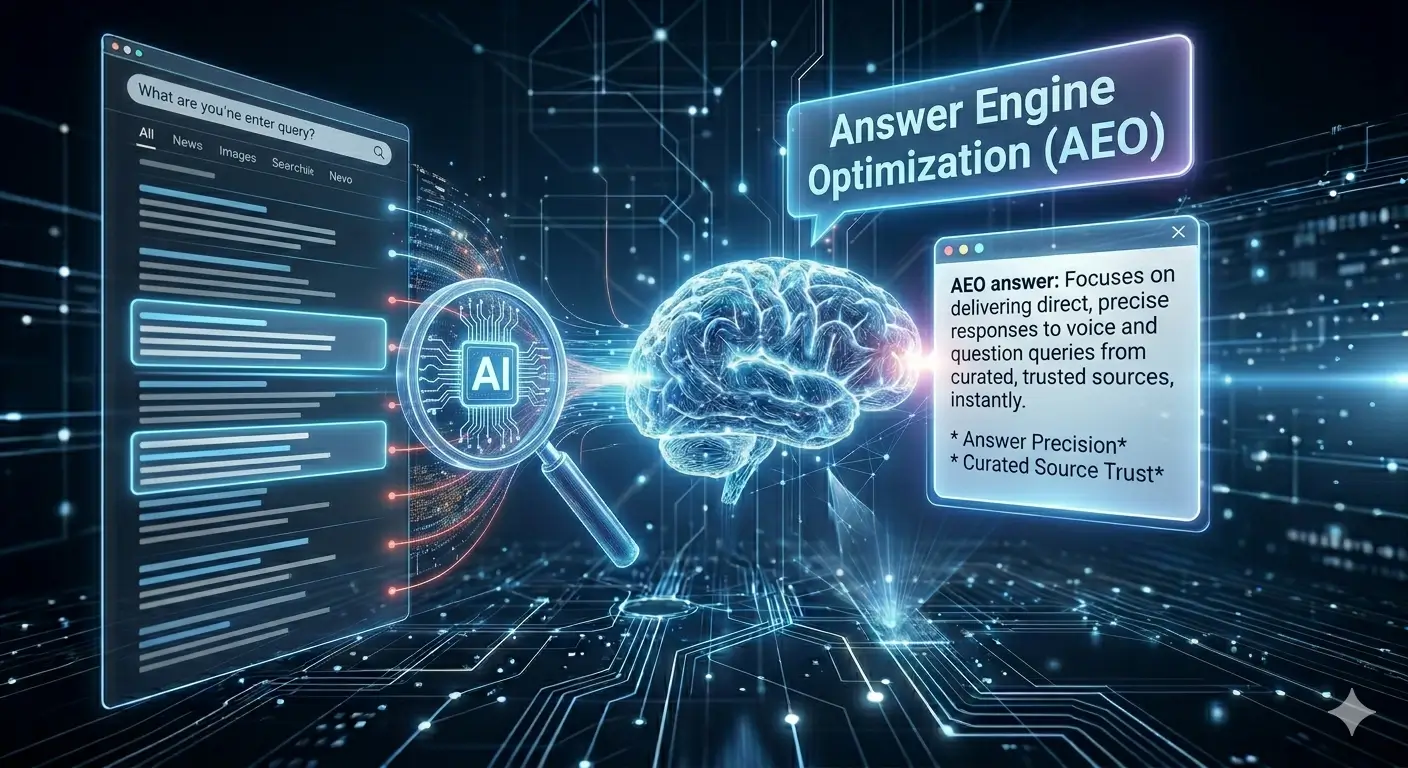
Answer Engine Optimization focuses on structuring content so it directly answers user queries in formats that AI systems, voice assistants, and featured snippets can extract instantly. This makes AEO a core pillar of modern search evolution, as explained in AEO vs GEO vs SEO and how they improve search visibility.
AEO is closely connected with Generative Engine Optimization (GEO) because both focus on AI content extraction, but GEO extends it into AI-generated summaries. It also aligns with SEO in 2026 and how traditional SEO is changing with AI search, which explains how traditional search is evolving into AI-first discovery systems.
This shift has created a new form of optimization called Answer Engine Optimization (AEO). Instead of optimizing only for rankings and clicks, AEO focuses on helping search engines and AI systems directly understand, extract, and present your content as the best possible answer. If your content is not optimized for AI-powered answer engines, you risk losing visibility even if your website ranks well in traditional search.
In this complete beginner guide, you’ll learn:
- What Answer Engine Optimization (AEO) is
- How AEO differs from traditional SEO
- Why AEO matters in 2026
- How AI answer engines work
- How to optimize your content for ChatGPT, Google AI Overviews, Gemini, and voice search
- The best AEO strategies for increasing AI visibility
- How to measure AEO success
- The future of AEO and AI-powered search
What Is Answer Engine Optimization (AEO)?
Answer Engine Optimization (AEO) is the process of optimizing content so search engines and AI systems can easily understand, extract, summarize, and display it as a direct answer to user queries. Unlike traditional SEO, which focuses mainly on ranking webpages in search results, AEO focuses on becoming the answer itself.
Your content may appear as:
- Google AI Overviews
- Featured snippets
- Voice assistant responses
- ChatGPT citations
- Perplexity sources
- Gemini-generated summaries
- “People Also Ask” answers
- Knowledge panels
- AI-generated search responses
In simple terms:
SEO helps users find your page.
AEO helps AI systems use your content as the answer.
This means your content must be:
- Clear
- Structured
- Accurate
- Easy to extract
- Factually trustworthy
- Conversational
- Optimized for user intent
AEO is becoming essential because modern search engines increasingly prioritize direct answers over lists of links.
Why Is AEO Important?
AEO matters because search behavior has fundamentally changed. Users are no longer searching only with short keywords like:
- “best CRM”
- “weather NYC”
- “SEO tips”
Instead, users ask conversational questions like:
- “What is the best CRM software for small businesses?”
- “How does Answer Engine Optimization work?”
- “What should I optimize for Google AI Overviews?”
AI systems now interpret intent, context, and meaning rather than simply matching keywords.
The Rise of Zero-Click Searches
One of the biggest reasons AEO matters is the growth of zero-click search. A zero-click search happens when users get their answer directly on the search results page without clicking a website.
Examples include:
- Google featured snippets
- AI Overviews
- Voice search answers
- Knowledge panels
- AI-generated summaries
This means businesses can lose organic traffic even while maintaining impressions. However, brands that become the source of those answers gain:
- Authority
- Brand recognition
- Trust
- AI citations
- Higher purchase influence
- Increased visibility across AI systems
Being cited by AI engines is becoming as valuable as traditional rankings.
AI Search Is Growing Rapidly
Modern AI-powered answer engines include:
- ChatGPT
- Google Gemini
- Google AI Overviews
- Perplexity AI
- Claude
- Microsoft Copilot
- DeepSeek AI
- Voice assistants like Siri and Alexa
These systems synthesize information from multiple websites and surface the most trusted, structured, and relevant answers. If your content is not optimized for these systems, your competitors may become the source AI engines trust instead.
AEO vs SEO: What’s the Difference?
Although AEO and SEO are closely connected, their goals are different.
| Traditional SEO | Answer Engine Optimization (AEO) |
|---|---|
| Focuses on rankings | Focuses on direct answers |
| Goal is clicks and traffic | Goal is citations and visibility |
| Keyword-focused | Conversational query-focused |
| Optimized for SERPs | Optimized for AI systems |
| Measures traffic | Measures answer visibility |
| Targets search engines | Targets answer engines and AI |
| Requires backlinks | Requires authority + structure |
Traditional SEO Focuses on Traffic
Traditional SEO aims to:
- Rank webpages higher
- Increase organic traffic
- Improve click-through rates
- Optimize keywords
- Build backlinks
- Improve technical SEO
The main goal is to get users to visit your website.
AEO Focuses on Being the Answer
AEO focuses on:
- Providing direct answers
- AI citations
- Featured snippets
- Conversational queries
- Voice search optimization
- Structured content
- Entity recognition
- Machine-readable information
Instead of simply ranking, your goal becomes becoming the trusted source AI engines use.
AEO and SEO Work Together
AEO is not replacing SEO.
In reality:
- Strong SEO improves AEO
- Strong AEO improves SEO
The best modern strategy combines:
- SEO
- AEO
- GEO (Generative Engine Optimization)
- UX optimization
- Content authority
Websites that balance all these areas will dominate future search visibility.
How Do Answer Engines Work?
To understand AEO, you first need to understand how AI answer engines process information.
Modern answer engines use:
- Natural Language Processing (NLP)
- Machine learning
- Large Language Models (LLMs)
- Structured data
- Knowledge graphs
- Entity relationships
- Contextual understanding
Their goal is to identify:
- The user’s intent
- The best possible answer
- The most trustworthy source
- The clearest explanation
Understanding User Intent
Every search has an intent.
Common search intents include:
- Informational
- Navigational
- Transactional
- Comparative
- Local
- Instructional
For example:
| Query | User Intent |
|---|---|
| “What is AEO?” | Definition |
| “How does AEO work?” | Educational |
| “Best SEO tools for AEO” | Comparison |
| “AEO strategies for blogs” | Implementation |
AEO content must directly satisfy the user’s intent quickly and clearly.
Natural Language Processing (NLP)
Search engines now use NLP to understand:
- Meaning
- Context
- Relationships
- Sentiment
- Query intent
- Conversational language
This is why modern content should sound natural rather than overly keyword stuffed.
Bad example:
“Best SEO company SEO services SEO optimization best SEO ranking.”
Good example:
“Answer Engine Optimization helps AI systems understand and present your content as direct answers in search results.”
Knowledge Graphs and Entities
AI systems rely heavily on entities.
An entity can be:
- A person
- A company
- A topic
- A place
- A concept
- A product
For example:
- ChatGPT
- SEO
- Apple
- Digital marketing
AEO content should clearly define entities and connect them logically. This helps AI systems understand relationships and build authority associations.
What Are AI Answer Engines?
AI answer engines are systems that generate direct answers instead of simply listing webpages.
ChatGPT
ChatGPT provides conversational answers using AI-generated summaries and web-based citations.
To optimize for ChatGPT:
- Use clear explanations
- Add concise definitions
- Create authoritative content
- Use FAQ sections
- Include updated statistics
Google AI Overviews
Google AI Overviews appear at the top of search results and summarize information from multiple sources.
To optimize for Google AI Overviews:
- Structure content clearly
- Use headings as questions
- Provide concise answers first
- Add schema markup
- Improve topical authority
Perplexity AI
Perplexity emphasizes citations and source references.
To optimize for Perplexity:
- Use fact-based content
- Add supporting evidence
- Cite reliable data
- Keep content fresh
Microsoft Copilot
Microsoft Copilot combines conversational AI with search results.
It favors:
- Clear structure
- Conversational answers
- Helpful formatting
- Reliable information
Voice Assistants
Voice search assistants include:
- Siri
- Alexa
- Google Assistant
These systems often provide only one answer.
That makes AEO critical for voice search visibility.
Key Components of a Successful AEO Strategy
Successful AEO requires multiple optimization layers working together.
1. Content Optimization for Direct Answers
AEO content should answer the primary question immediately.
Best practices:
- Start sections with direct answers
- Keep answers concise initially
- Expand afterward with detailed explanations
- Use clear language
- Avoid unnecessary fluff
Ideal Structure
Example:
What Is AEO?
Answer Engine Optimization (AEO) is the process of optimizing content so AI systems can understand and display it as direct answers.
Then expand into:
- Examples
- Benefits
- Strategies
- Context
- Case studies
This structure helps AI systems extract answers easily.
2. Use Question-Based Headings
AI systems love question-based content.
Examples:
- What Is Answer Engine Optimization?
- How Does AEO Work?
- Why Is AEO Important?
- What Is the Difference Between AEO and SEO?
Question-based headings align directly with conversational search behavior.
3. Add FAQ Sections
FAQ sections are one of the best AEO optimization strategies.
Why?
Because they:
- Match conversational queries
- Improve extractability
- Increase featured snippet opportunities
- Help voice search visibility
- Improve AI readability
Good FAQ answers are:
- Short
- Clear
- Accurate
- Direct
4. Implement Structured Data (Schema Markup)
Structured data helps search engines understand your content.
Important schema types for AEO include:
- FAQ schema
- HowTo schema
- Article schema
- Product schema
- Organization schema
- Review schema
Example FAQ Schema
{
  "@context": "https://schema.org",
  "@type": "FAQPage",
  "mainEntity": [{
    "@type": "Question",
    "name": "What is Answer Engine Optimization?",
    "acceptedAnswer": {
      "@type": "Answer",
      "text": "Answer Engine Optimization helps AI systems understand and display content as direct answers."
    }
  }]
}
Schema markup improves:
- Rich results
- Featured snippets
- AI understanding
- Search visibility
5. Optimize for Featured Snippets
Featured snippets are one of the biggest AEO opportunities.
Google often extracts snippets from:
- Lists
- Definitions
- Tables
- FAQs
- Step-by-step content
Featured Snippet Tips
- Use concise paragraphs
- Add numbered lists
- Use bullet points
- Create comparison tables
- Keep definitions short and clear
6. Optimize for Voice Search
Voice search queries are longer and more conversational.
Example:
Text query:
“best CRM software”
Voice query:
“What is the best CRM software for remote teams?”
Voice Search Optimization Tips
- Use natural language
- Write conversationally
- Target long-tail queries
- Add local intent phrases
- Improve page speed
- Optimize mobile UX
Voice search optimization and AEO are deeply connected.
7. Improve Content Freshness
AI systems prefer updated content.
Fresh content increases:
- AI trust
- Citation potential
- SERP visibility
- Topical relevance
Update:
- Statistics
- Examples
- Trends
- Screenshots
- Case studies
- Tool recommendations
Quarterly content updates work extremely well for AEO.
8. Build Topical Authority
Topical authority means becoming deeply trusted on a specific subject.
You build topical authority through:
- Interlinked content clusters
- Comprehensive guides
- Supporting articles
- Consistent publishing
- Expert-level information
For example:
If you want authority in AEO, create supporting content like:
- AEO vs SEO
- Best AEO tools
- How AI search works
- Featured snippet optimization
- Voice search SEO
- Schema markup guides
- GEO vs AEO
- AI visibility strategies
Strong internal linking strengthens topical relevance.
Best Content Formats for AEO
Certain content formats perform better in answer engines.
Structured Explanations
AI systems prefer clearly structured explanations.
Best format:
- Definition
- Context
- Examples
- Key takeaways
FAQ Content
FAQ content naturally aligns with conversational AI.
AI systems frequently pull answers directly from FAQs.
How-To Guides
Step-by-step guides work extremely well.
Use:
- Numbered steps
- Clear instructions
- Action verbs
- Outcomes
Comparison Content
Comparison articles are highly cited by AI systems.
Examples:
- AEO vs SEO
- GEO vs SEO
- ChatGPT vs Perplexity
- AI Overviews vs featured snippets
Use comparison tables whenever possible.
Data-Driven Content
AI systems trust factual content.
Include:
- Statistics
- Research
- Studies
- Benchmarks
- Case studies
- Original insights
Always update outdated statistics.
How to Optimize Existing Content for AEO
You do not need to rewrite your entire website.
Instead, start optimizing your highest-performing content.
Quick AEO Optimization Checklist
Add Direct Answers
Start every section with a concise answer.
Rephrase Headings as Questions
Instead of:
“Benefits of AEO”
Use:
“What Are the Benefits of AEO?”
Add FAQs
Include FAQ sections throughout content.
Improve Structure
Use:
- Short paragraphs
- Bullet points
- Tables
- Headings
- Lists
Add Schema Markup
Implement:
- FAQ schema
- Article schema
- HowTo schema
Update Old Statistics
AI systems prefer recent information.
Improve Readability
Keep paragraphs short and scannable.
How to Measure AEO Success
Traditional SEO metrics alone are no longer enough.
You also need to track AI visibility.
Important AEO Metrics
Featured Snippet Visibility
Track:
- Impressions
- Clicks
- Queries
- Featured snippet ownership
Use Google Search Console.
AI Citations
Search for your target topics in:
- ChatGPT
- Perplexity
- Gemini
- Google AI Overviews
Look for:
- Brand mentions
- Source citations
- Links to your content
“People Also Ask” Visibility
Track how frequently your content appears in:
- PAA boxes
- Rich results
- Direct answer sections
Voice Search Visibility
Monitor long-tail conversational query performance. These often indicate voice search success.
Brand Authority Signals
Monitor:
- Brand mentions
- Backlinks
- Citation growth
- Knowledge panel appearances
- AI-generated references
Challenges of AEO
Although AEO offers major opportunities, it also has challenges.
Constant Algorithm Changes
AI systems evolve rapidly.
Google, OpenAI, and other platforms continuously update:
- Ranking systems
- NLP models
- AI summaries
- Citation systems
AEO strategies must remain adaptable.
Declining Organic Clicks
Zero-click search may reduce website traffic.
However, brands still gain:
- Visibility
- Trust
- Recognition
- Authority
- Purchase influence
Success is shifting from clicks to visibility.
AI Citation Inconsistency
AI systems do not always cite sources consistently.
Sometimes they:
- Summarize without linking
- Mention brands without citations
- Mix multiple sources together
This makes measurement more difficult.
The Future of AEO
The future of search is:
- Conversational
- AI-powered
- Voice-driven
- Context-aware
- Personalized
- Entity-based
AEO will become even more important as:
- AI assistants grow
- Voice search expands
- Google AI Overviews increase
- LLM search evolves
- Users rely more on conversational search
Businesses that optimize early will gain a massive advantage.
AEO Best Practices Summary
Here are the most important AEO best practices:
Use Conversational Language
Write naturally and answer questions directly.
Focus on User Intent
Understand what users truly want.
Add FAQs Everywhere
FAQs improve extractability and AI understanding.
Structure Content Clearly
Use headings, tables, bullets, and short paragraphs.
Use Schema Markup
Help AI systems understand your content.
Optimize for Featured Snippets
Create concise answer blocks.
Keep Content Fresh
Update content regularly.
Build Topical Authority
Create interconnected content clusters.
Improve User Experience
Fast-loading, mobile-friendly websites perform better.
Frequently Asked Questions (FAQs)
What Is Answer Engine Optimization?
Answer Engine Optimization (AEO) is the process of optimizing content so AI-powered search engines and answer systems can extract and display it as direct answers.
Is AEO Different from SEO?
Yes. SEO focuses on rankings and traffic, while AEO focuses on direct answers, AI citations, and answer visibility.
Does AEO Replace SEO?
No. AEO complements SEO. Modern websites should optimize for both.
What Are Examples of Answer Engines?
Examples include:
- ChatGPT
- Google AI Overviews
- Gemini
- Perplexity
- Claude
- Microsoft Copilot
- Siri
- Alexa
Why Is AEO Important?
AEO helps brands gain visibility in AI-generated search experiences and zero-click searches.
What Type of Content Works Best for AEO?
The best content types include:
- FAQs
- How-to guides
- Comparison articles
- Definitions
- Lists
- Data-driven content
- Expert insights
How Do I Optimize Content for AEO?
You can optimize by:
- Adding direct answers
- Using question-based headings
- Implementing schema markup
- Improving structure
- Updating content regularly
- Creating FAQs
- Building topical authority
What Is Zero-Click Search?
Zero-click search happens when users get answers directly on the SERP without visiting a website.
Does AEO Reduce Website Traffic?
It can reduce some clicks, but it also increases:
- Brand visibility
- Authority
- Trust
- AI citations
- Purchase influence
Is AEO Important for Local Businesses?
Yes. Local businesses benefit from:
- Voice search
- “Near me” queries
- AI-generated recommendations
- Local answer visibility
Final Thoughts
Answer Engine Optimization (AEO) is no longer optional.
As AI-powered search engines continue evolving, businesses must optimize not only for rankings but also for direct answers, AI citations, and conversational search visibility.
The websites that win in 2026 and beyond will be those that:
- Answer user questions clearly
- Structure content effectively
- Build topical authority
- Optimize for AI systems
- Keep content updated
- Focus on trust and expertise
AEO is not the end of SEO. It is the next evolution of search optimization. If you start implementing AEO strategies now, your brand will be far better positioned for the future of AI-powered search.