
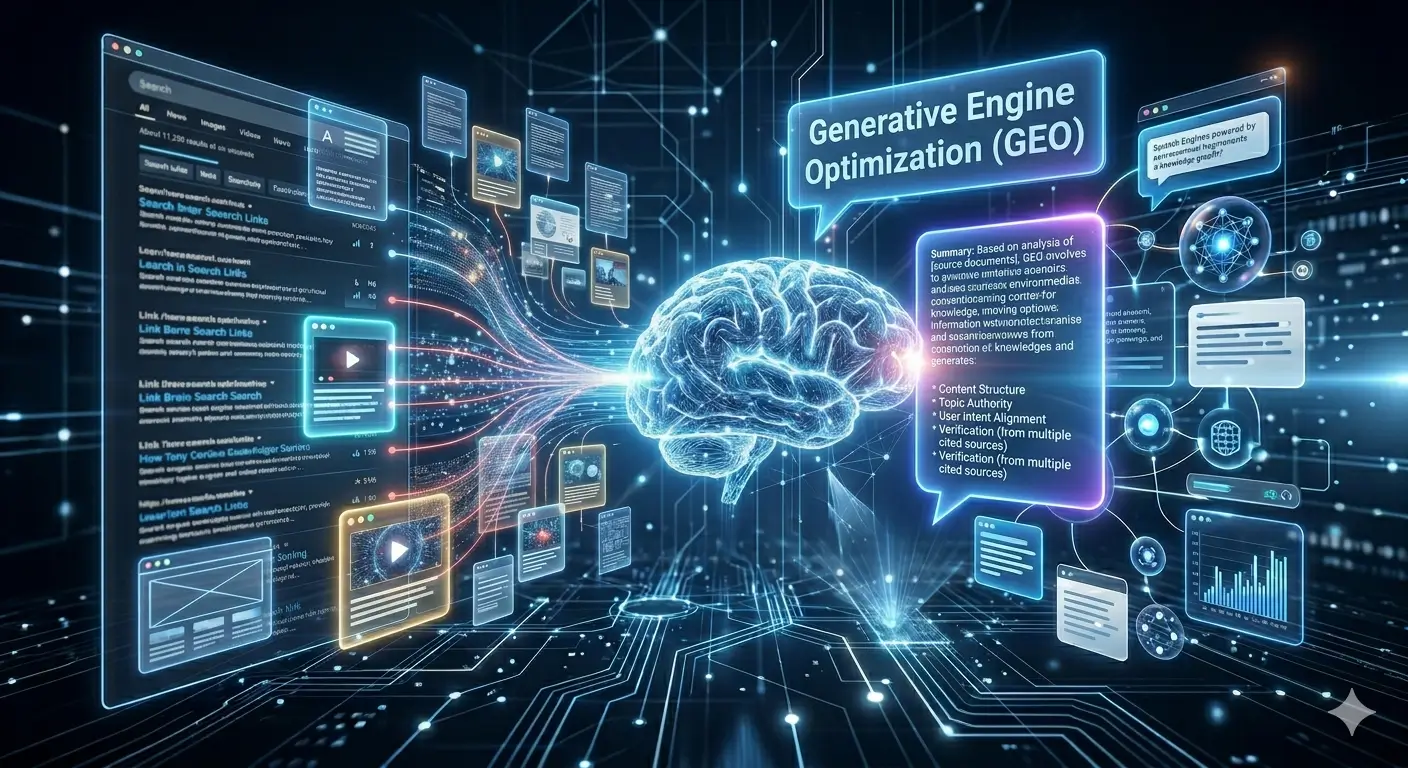
The way people search online is changing rapidly. Instead of only clicking blue links on traditional search engines, users are now asking conversational questions to AI-powered platforms like OpenAI’s ChatGPT, Google Gemini, Anthropic Claude, and Perplexity AI. These AI systems generate direct answers instead of simply displaying webpages. This shift has created a new digital marketing strategy called Generative Engine Optimization (GEO).
What Is Generative Engine Optimization (GEO)?
Generative Engine Optimization (GEO) is the process of optimizing content for AI-powered search engines and generative AI platforms. Instead of focusing only on keyword rankings, GEO helps content become part of AI-generated responses. Platforms such as ChatGPT, Gemini, Claude, Google AI Overviews, and Perplexity analyze large amounts of information and generate summarized answers for users. GEO ensures your website content can be discovered, understood, trusted, and included in those AI responses. This strategy is part of the broader framework explained in AEO vs GEO vs SEO and how they improve search visibility.
Generative Engine Optimization focuses on helping brands, websites, and content appear inside AI-generated answers. Traditional SEO was mainly about ranking webpages on search engines. GEO is about making your content understandable, trustworthy, and useful enough for AI systems to reference, summarize, or recommend in their responses. Businesses that adapt early to AI search optimization can gain a major visibility advantage as AI-powered search continues growing. It is heavily influenced by how AI systems evaluate content, which is why understanding AI search ranking in ChatGPT and Google SGE is important. It also overlaps with Answer Engine Optimization (AEO) because both focus on extracting usable answers for AI-driven search experiences.
Unlike traditional SEO, which primarily targets search engine algorithms, generative engine optimization focuses heavily on user intent, context, topical authority, entity relationships, structured information, and conversational relevance. AI search systems prioritize content that clearly answers questions, demonstrates expertise, and provides complete explanations. This means websites must move beyond keyword stuffing and start creating genuinely useful, authoritative, and context-rich content.
Key Elements of GEO
- Context-focused optimization
- Conversational content structure
- Clear and direct answers
- Topical authority building
- Structured data implementation
- Entity-based SEO
- High content accuracy
- AI-friendly formatting
- Semantic relevance
- Trust and credibility signals
GEO SEO vs Traditional SEO
Although GEO SEO and traditional SEO are connected, they are not identical. Traditional SEO mainly focuses on improving rankings in search engine result pages (SERPs). GEO expands that concept by optimizing content for AI-generated answers and conversational search experiences.
| Traditional SEO | GEO SEO |
|---|---|
| Focuses on rankings | Focuses on AI visibility |
| Targets search engines | Targets AI systems and LLMs |
| Blue link clicks matter most | Brand mentions and citations matter |
| Keyword optimization centered | Context and intent centered |
| Meta tags and backlinks important | Entity clarity and answer quality important |
| Search traffic is main KPI | AI mentions and influence are key KPIs |
Generative AI search engines do not simply rank pages. They synthesize information from multiple sources and create unique responses. Because of this, your content must be highly structured, trustworthy, and comprehensive if you want AI systems to reference it.
How AI Search Works
AI search engines work differently from traditional search engines. Instead of only indexing and ranking webpages, AI systems analyze information deeply using natural language processing (NLP), machine learning, and large language models (LLMs). They attempt to understand what the user actually means, not just the keywords typed into the search box.
When a user asks a question like “What is the best way to improve local SEO for limousine companies?”, AI systems process the intent behind the query. They then gather information from training data, live search indexes, trusted sources, and contextual relationships between entities. Finally, the system generates a complete answer instead of simply showing a list of webpages.
How Generative AI Search Processes Queries
- Understands user intent
- Analyzes context and semantics
- Retrieves relevant information
- Evaluates source credibility
- Generates summarized answers
- Sometimes cites trusted sources
- Continuously refines responses
This is why AI search optimization has become essential. AI systems prefer content that is easy to understand, clearly structured, factually accurate, and highly relevant to user intent.
Why Generative Engine Optimization Matters
AI-generated answers are reducing traditional click-through behavior. Many users now receive answers directly within AI interfaces without visiting multiple websites. This means businesses must optimize not just for rankings but also for AI inclusion and brand visibility inside generated responses.
If your website content becomes part of AI-generated answers, your brand gains authority, trust, and visibility even when users do not immediately click your website link. GEO helps businesses stay discoverable in this new search landscape where conversational AI is becoming the default way people search for information.
Benefits of GEO SEO
- Increased AI search visibility
- Better brand recognition
- Higher authority and trust
- Improved user engagement
- Enhanced topical authority
- Better semantic relevance
- Stronger long-term organic presence
- Greater visibility across AI platforms
- More opportunities for branded mentions
- Better adaptation to future search trends
Businesses that ignore generative engine optimization risk losing visibility as AI search continues replacing traditional search behavior.
AI Platforms Driving GEO Growth
Several AI-powered platforms are shaping the future of search and making GEO increasingly important. These systems use advanced large language models to provide conversational answers and summaries.
Popular AI Search Platforms
- ChatGPT
- Google AI Overviews
- Gemini
- Claude
- Perplexity AI
- Microsoft Copilot
- Bing AI
- You.com
Each platform works differently. Some rely heavily on live web retrieval, while others depend more on training data and cached knowledge. This means GEO strategies must remain flexible and adaptable across different AI ecosystems.
How to Optimize Content for GEO
Optimizing for generative engines requires a combination of traditional SEO best practices and AI-focused optimization methods. The goal is to create content that AI systems can easily interpret, trust, and include within generated responses.
1. Build Topical Authority
Topical authority is one of the biggest ranking and AI visibility factors. Instead of publishing random blogs, websites should create clusters of deeply connected content around a central topic. AI systems favor websites that demonstrate consistent expertise within a niche.
For example, if your website focuses on digital marketing, you should create interconnected content about:
- GEO SEO
- AI search optimization
- ChatGPT SEO
- Technical SEO
- Structured data
- Semantic SEO
- Entity optimization
- Content strategy
- AI Overviews
- Conversational search
Internal linking helps AI systems understand your expertise depth and topic relationships.
2. Use Conversational Language
AI search engines are designed around natural language interactions. Content written in a conversational tone performs better because it aligns with how users ask questions in AI platforms.
Instead of writing robotic keyword-heavy content, focus on answering real user questions naturally. Use FAQ sections, detailed explanations, and conversational phrasing. This improves readability while helping AI systems understand context more accurately.
3. Create Comprehensive Content
Thin content rarely performs well in AI-driven search environments. Generative engines prefer in-depth pages that completely answer a user’s query. Long-form content with supporting examples, comparisons, statistics, explanations, and structured sections has a higher chance of being referenced.
Comprehensive content signals expertise, trustworthiness, and authority. AI systems want reliable sources that provide complete information rather than shallow summaries.
4. Optimize for Entities and Semantic SEO
Modern AI search engines rely heavily on entities and semantic relationships. Instead of only matching keywords, they analyze how topics, brands, people, and concepts connect together.
For example, a GEO SEO article should naturally connect related entities like:
- ChatGPT SEO
- AI search optimization
- Large Language Models
- Google AI Overviews
- Semantic SEO
- Structured data
- NLP
- Machine learning
This helps AI systems understand topical relevance more effectively.
5. Implement Structured Data
Structured data and schema markup help AI systems interpret website content more efficiently. Schema provides additional context about articles, products, businesses, FAQs, reviews, and authors.
Important schema types for GEO include:
- FAQ schema
- Article schema
- Organization schema
- Local business schema
- Product schema
- Review schema
- Breadcrumb schema
Structured information improves content discoverability for both traditional search engines and AI systems.
GEO SEO and ChatGPT SEO
ChatGPT SEO is becoming a major discussion in digital marketing because businesses want visibility within AI-generated answers. ChatGPT and similar LLMs generate responses using both trained knowledge and external sources depending on the platform version and browsing capabilities.
To improve ChatGPT SEO visibility:
- Publish highly authoritative content
- Build strong brand mentions online
- Earn citations from trusted sources
- Use clear and factual language
- Maintain updated content
- Build topical depth
- Create structured information
- Improve entity recognition
- Gain positive reviews and mentions
AI systems often prefer content from websites already viewed as authoritative across the internet.
Challenges of Generative Engine Optimization
Although GEO provides major opportunities, it also introduces new challenges. AI-generated search results are less predictable than traditional rankings. The same prompt may generate different answers at different times depending on the platform, personalization, training data, or retrieval methods.
Common GEO Challenges
- Constant AI algorithm changes
- Difficulty measuring AI visibility
- Reduced traditional traffic
- Unstable answer generation
- Limited transparency from AI platforms
- Increased competition for citations
- Need for continuous content updates
- Balancing AI optimization with human readability
Because AI search is evolving rapidly, businesses must continuously test, measure, and refine their GEO strategies.
Future of AI Search Optimization
The future of search is moving toward conversational and generative experiences. AI systems are becoming more advanced at understanding language, intent, context, and personalization. As this evolution continues, GEO SEO will become a core part of digital marketing strategies.
Traditional SEO will still matter, but generative engine optimization will increasingly influence online visibility. Businesses that combine SEO fundamentals with AI search optimization strategies will have the strongest long-term search presence.
Future GEO trends may include:
- Increased AI-generated shopping recommendations
- Voice and multimodal search growth
- Personalized AI assistants
- Deeper entity understanding
- Greater importance of brand authority
- More conversational search experiences
- Stronger semantic search systems
- Real-time AI-generated answers
Websites that focus on quality, trust, authority, and helpful content will likely perform best across both traditional and AI-driven search systems.
Frequently Asked Questions About Generative Engine Optimization (GEO)
1. What are generative engine optimization tools?
Generative engine optimization tools are platforms and software designed to help businesses optimize their content for AI-driven search engines and generative AI systems. These tools analyze search intent, conversational queries, topical authority, semantic relevance, and AI visibility opportunities. Popular GEO SEO tools include Surfer SEO, Frase, MarketMuse, Clearscope, Semrush, and AI-focused analytics platforms that track brand mentions across ChatGPT, Perplexity, Gemini, and Google AI Overviews. These tools help marketers create AI-friendly content structures, improve contextual relevance, and strengthen visibility in generative search environments.
2. What are some generative engine optimization examples?
A common generative engine optimization example is creating detailed content that directly answers conversational questions users ask AI platforms. For instance, a digital marketing agency may publish a comprehensive guide on “How AI Search Works” with structured headings, FAQs, semantic keywords, and entity-based optimization. AI systems like ChatGPT or Perplexity may then reference or summarize that content within generated answers. Another GEO example is optimizing FAQ pages with conversational language so Google AI Overviews can pull answers directly into search summaries.
3. What are the best generative engine optimization strategies?
The best generative engine optimization strategies focus on improving topical authority, semantic relevance, content depth, and AI readability. Businesses should create comprehensive content clusters around core topics instead of publishing isolated articles. GEO strategies also include using conversational language, adding schema markup, optimizing entities, improving content freshness, and earning authority mentions from trusted websites. Since AI search engines prioritize trust and contextual understanding, brands must focus on producing valuable and accurate information that directly satisfies user intent rather than simply targeting keywords.
4. What are generative engine optimization best practices?
Generative engine optimization best practices include writing high-quality long-form content, structuring pages clearly with headings and FAQs, implementing schema markup, and maintaining strong topical relevance across a website. It is also important to use natural language because AI platforms process conversational queries differently than traditional search engines. Updating content regularly, building strong internal linking structures, and improving entity recognition are also critical GEO best practices. Websites that demonstrate expertise, authority, and trustworthiness are more likely to appear in AI-generated answers.
5. What is GEO AI search?
GEO AI search refers to AI-powered search experiences where users receive generated answers instead of only traditional search results. Platforms such as ChatGPT, Gemini, Claude, and Perplexity use large language models and machine learning to understand questions and generate contextual responses. GEO AI search changes how businesses approach SEO because visibility now depends on whether AI systems can understand and trust your content. This shift has made AI search optimization an important part of modern digital marketing strategies.
6. Is there a Generative Engine Optimization PDF available?
Yes, many digital marketing agencies, SEO platforms, and AI research companies provide Generative Engine Optimization PDF guides, whitepapers, and case studies. These PDFs usually explain GEO fundamentals, AI search behavior, optimization techniques, content strategies, and emerging trends in AI-driven search. Businesses often use these downloadable resources to train teams, develop AI SEO strategies, and understand how platforms like ChatGPT and Google AI Overviews influence search visibility.
7. Is there a Generative Engine Optimization course available online?
Yes, several online learning platforms and digital marketing companies now offer Generative Engine Optimization courses. These courses teach marketers how AI search engines work, how large language models process information, and how to optimize websites for conversational search experiences. Most GEO courses cover topics like semantic SEO, entity optimization, AI content strategy, schema markup, topical authority, and AI visibility tracking. As AI-powered search continues growing, GEO education is becoming increasingly valuable for SEO professionals and marketers.
8. Can you get a Generative Engine Optimization certification?
Yes, some SEO training organizations and AI marketing academies are beginning to offer Generative Engine Optimization certification programs. These certifications validate knowledge of AI search optimization, generative AI systems, semantic SEO, and conversational content strategy. A GEO certification can help digital marketers stay competitive as AI search platforms become more important in online visibility and search marketing. Businesses are increasingly seeking professionals who understand how to optimize content for both traditional search engines and AI-driven answer engines.
9. How is GEO different from traditional SEO?
Traditional SEO focuses mainly on improving rankings in search engine result pages using keywords, backlinks, and technical optimization. GEO SEO expands beyond rankings and focuses on helping AI systems understand, trust, and reference your content in generated answers. Instead of only optimizing for clicks, generative engine optimization aims to increase AI visibility, brand mentions, contextual relevance, and authority in conversational search environments. GEO combines traditional SEO principles with AI-focused optimization strategies.
10. Why is generative engine optimization important for the future?
Generative engine optimization is important because AI-powered search is rapidly changing how users discover information online. More people now use AI tools like ChatGPT and Perplexity to receive direct answers rather than browsing multiple websites. Businesses that optimize for AI search can improve brand visibility, build authority, and remain competitive as search behavior evolves. GEO helps websites adapt to conversational search experiences, semantic AI systems, and the growing importance of contextual relevance in modern search marketing.
Final Thoughts
Generative Engine Optimization (GEO) is transforming the future of digital visibility. As AI-powered platforms like ChatGPT, Gemini, Claude, Perplexity, and Google AI Overviews continue changing how people search, businesses must evolve beyond traditional SEO strategies.
GEO SEO focuses on helping AI systems understand, trust, and reference your content within generated answers. This requires strong topical authority, conversational content, semantic optimization, structured data, and user-focused information architecture. AI search optimization is no longer optional for brands wanting long-term online visibility.
The future of search belongs to businesses that create high-quality, context-rich, and trustworthy content designed for both humans and AI systems.