
Written by the Eagles Media Enterprises Team — 12+ years and 500+ client campaigns in SEO and web development
Why Multi-Location Dental SEO Is a Different Problem Entirely
Multi-location dental SEO isn’t single-location SEO repeated several times — it’s a structural problem that, done wrong, actively works against the group instead of for it. A dental group or DSO with three, five, or twenty offices isn’t just competing against other practices; it’s at risk of competing against itself, with its own location pages fighting each other for the same searches instead of each one owning its own market. As a full-service SEO Company USA, we’ve helped multi-location healthcare groups restructure exactly this kind of self-competing setup. Our SEO for dentists guide flags this as one of the most common structural mistakes dental groups make — this guide is the full breakdown of how to fix it and build it correctly from the start.
The Core Mistake: One Page or One Template for Every Location
The two most common approaches both fail the same way, for different reasons.
A single combined “our locations” page listing every address on one page gives Google no clear page to rank for “dentist near [neighborhood]” — there’s nothing location-specific for it to match the search to, so the whole group underperforms in every individual market.
A duplicated template with only the city name swapped looks like more content, but Google recognizes the pattern. Near-identical pages competing for similar searches often suppress each other rather than each ranking independently — the group ends up with several weak pages instead of one strong one.
Both mistakes come from treating locations as an afterthought of the main site rather than as their own, fully-developed pages.
What Multi-Location Dental SEO Actually Requires
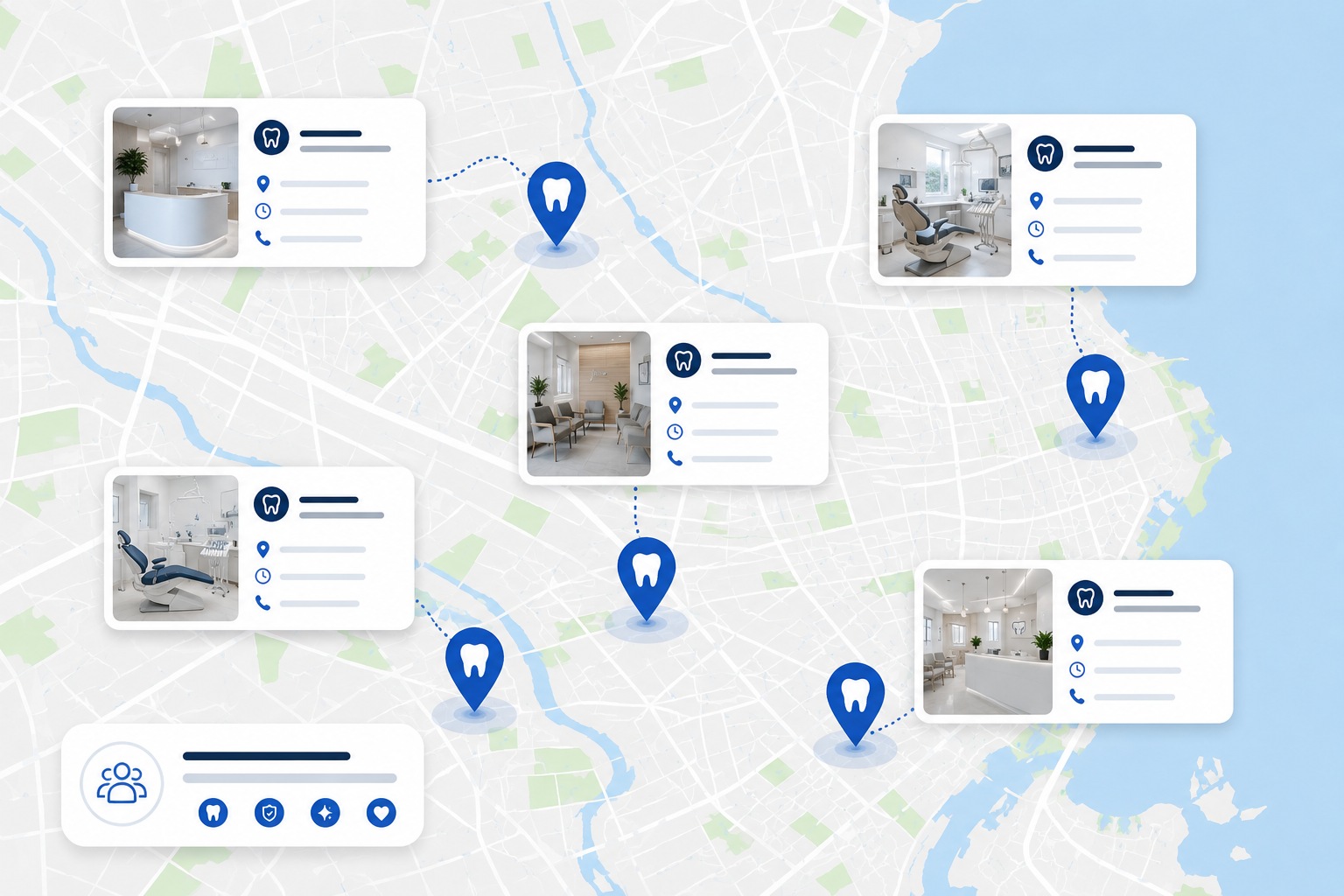
A genuinely distinct page per location. Real photos of that specific office, the actual staff who work there, neighborhood-specific detail, and hours and services particular to that location — not a copy-pasted paragraph with the city name changed.
A separate, fully optimized Google Business Profile per location. Each office needs its own profile, correctly categorized, with its own reviews and its own consistent NAP details. Our Google Business Profile for dentists guide covers the full setup — every principle in it applies per location, not once for the whole group. For groups managing this across many offices, professional Google Business Profile management keeps every location’s profile consistent without relying on in-house staff to handle it manually.
Consistent citations across every directory, for every location. This is where multi-location groups run into trouble fastest, since one mismatched address multiplies across dozens of directories per office. Our guide to dental citations and NAP consistency covers exactly how to audit and fix this — for a group, that audit needs to run per location, not once for the brand.
A site structure that supports the load. A group’s website needs a logical hierarchy connecting each location page back to the group’s core services, without collapsing everything into one generic template. This is foundational dental website design work built on a strong web design foundation — get this structure wrong at the build stage and it’s expensive to unwind later.
Internal Linking Between Locations: Helpful or Harmful?
Done right, linking between your own location pages helps patients find the closest office and helps Google understand your overall footprint. Done wrong — stuffing every location link into every page’s footer with identical anchor text — it looks templated and dilutes the specific relevance each page is trying to build.
The better approach: link only to genuinely nearby locations where a patient might reasonably choose between them, using natural language (“Also serving the [nearby area] area? Visit our [location] office”) rather than a repetitive directory list on every single page.
Reviews at Scale: The Same Rules, More Moving Parts
Reviews remain one of the strongest local ranking signals per location, but a multi-location group has to manage this consistently across every office rather than letting some locations get attention while others go quiet. The same compliance-aware approach applies everywhere — review requests and responses can’t reference specific treatments or confirm patient identity, regardless of which office is involved. A group with fifteen locations needs a repeatable system, not fifteen separate improvised approaches.
Where Emergency Care Fits for Multi-Location Groups
If some or all of your locations offer emergency or same-day care, that needs to be clear on each relevant location page individually — a patient in pain is searching for the nearest office that can see them now, not a generic group-wide emergency policy buried on a different page. Our guide to emergency dentist SEO covers what that page needs; for a group, the same principles apply location by location.
Budgeting for a Multi-Location Campaign
Cost scales with location count, since each office needs its own optimized page, its own Google Business Profile, and its own citation cleanup — roughly three times the local SEO work for a three-location group compared to a single practice. Our SEO for dentist pricing guide breaks down where multi-location and DSO campaigns typically fall in the premium tier, and why that scope is different from a single-office retainer.
Frequently Asked Questions
How many pages does a multi-location dental group need?
At minimum, one fully distinct page per physical location, plus core service pages at the group level. A five-location group needs five location pages, not one combined page or five near-identical templates.
Can locations share the same service pages, or does every office need its own?
Core service content (what Invisalign is, how implants work) can live at the group level and be linked from each location page. What must stay unique per location is the practical, local detail — address, staff, hours, reviews, and neighborhood context.
Does a DSO need a different approach than an independent multi-location practice?
The core principles are the same, but DSOs often manage more locations across more markets, which raises the importance of a consistent, repeatable system for citations, reviews, and profile management rather than handling each location ad hoc.
How long does it take to fix a poorly structured multi-location site?
Restructuring location pages and cleaning up citations across several offices typically takes a few months to fully roll out, with individual locations often showing map-pack movement as their specific page and profile go live.
Ready to Make Every Location Rank on Its Own?
If your dental group’s locations are competing with each other instead of the competition, get in touch with our team and we’ll build a structure where every office earns its own visibility.
Eagles Media Enterprises
400 Ravinia Pl Suite B, Orland Park, IL 60462
Eagles Media Enterprises helps dental groups and DSOs rank higher, get found, and book more patients — in every market they serve.