
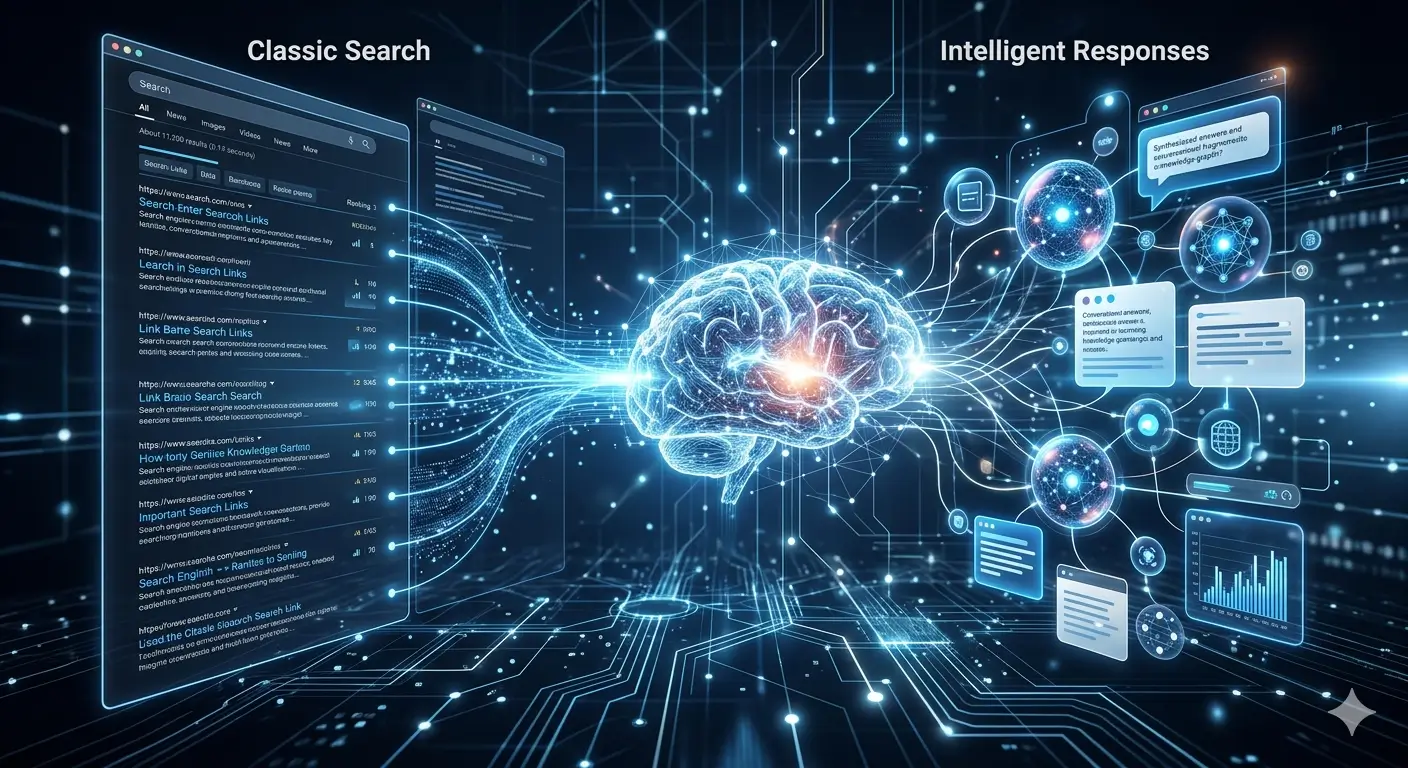
Traditional SEO is evolving rapidly as search engines shift toward AI-driven discovery, entity understanding, and semantic ranking systems. Modern strategies now require understanding how SEO integrates with AI search behavior, not just keyword optimization. This transformation is deeply connected to AEO vs GEO vs SEO and how they improve search visibility.
To adapt to this shift, SEO must now align with AI search ranking factors in ChatGPT and Google SGE, where content is evaluated based on meaning, authority, and context rather than traditional ranking signals alone. This is also why structured content and schema become increasingly important in modern search ecosystems.
AI interprets, synthesizes, and generates answers. Platforms like Google AI Overviews, ChatGPT, and other LLM-powered engines are fundamentally changing how users interact with search results.
This shift has redefined the entire concept of SEO trends 2026, moving the industry from “ranking pages” to “becoming part of AI-generated answers.” Visibility is no longer determined only by position on a search results page but by whether a brand is cited, summarized, or referenced within AI responses.
This is the new reality of AI and SEO, where content must be engineered not just for indexing—but for interpretation.
The Structural Shift: From Search Engines to Answer Engines
Traditional search engines were built around crawling, indexing, and ranking webpages. But modern AI search systems operate differently. They break content into semantic units, evaluate credibility, and reconstruct answers dynamically.
This is the foundation of search evolution in 2026.
Instead of:
- User searches → list of blue links → click → website
We now have:
- User question → AI model → synthesized answer → optional citations
This eliminates the assumption that traffic must come from clicks. In many cases, the user never visits a website at all.
The new question becomes:
“Are we part of the answer, or are we excluded from it?”
What Is Changing in SEO (Core Transformation Layer)
SEO in 2026 is no longer a single-channel optimization practice. It is a multi-layer visibility system that spans:
- Traditional search engines
- AI Overviews
- LLM chat systems
- Agent-based search tools
- Zero-click environments
This evolution defines the modern future of SEO.
Key transformation:
Search is shifting from:
“Find the best page”
To:
“Generate the best answer using multiple sources”
AI and SEO: The New Discovery Model
AI systems like ChatGPT and Google’s AI Overviews do not rank pages in isolation. Instead, they:
- Extract facts from multiple sources
- Evaluate credibility signals
- Identify entities and relationships
- Synthesize a unified response
This introduces a new optimization layer called AI search optimization.
Unlike traditional SEO, AI SEO focuses on:
- Extractability of content
- Structured clarity
- Entity recognition
- Context completeness
- Machine trust signals
AI does not “rank pages.” It reconstructs meaning.
Traditional SEO vs AI SEO (Core Framework)
| Dimension | Traditional SEO | AI SEO (2026) |
|---|---|---|
| Goal | Rank pages | Be cited in AI answers |
| Output | Blue links | Synthesized responses |
| Focus | Keywords | Entities + meaning |
| Optimization | On-page + backlinks | Structured + semantic clarity |
| Success metric | Clicks & rankings | Citations & AI visibility |
| Content behavior | Page-based | Chunk-based extraction |
| User journey | Search → click | Ask → answer → optional click |
This shift is the foundation of modern SEO trends 2026.
Why Traditional SEO Still Matters (But Isn’t Enough)
Despite the rise of AI systems, traditional SEO is not obsolete. It remains the data foundation layer for AI systems.
Search engines still rely on:
- Crawlable pages
- Indexable content
- Authority signals
- Structured markup
- Backlink ecosystems
AI systems like those from OpenAI still depend on web content as their source material.
However, the role of SEO has changed:
Traditional SEO = Access layer
AI SEO = Interpretation layer
GEO (Generative Engine Optimization) = Synthesis layer
Together, they form the modern search stack.
The Rise of Generative Engine Optimization (GEO)
One of the most important developments in future of SEO strategy is Generative Engine Optimization.
GEO focuses on optimizing content so AI systems can:
- Summarize it accurately
- Reuse it safely
- Cite it correctly
- Integrate it into generated answers
Unlike traditional SEO, GEO does not care only about ranking—it cares about representation accuracy in AI outputs.
This is critical because AI systems may:
- Merge multiple sources
- Paraphrase incorrectly
- Misattribute facts
- Exclude important brands
GEO ensures your brand is not just visible—but correctly interpreted.
Why AI Search Is Reshaping User Behavior
User behavior has changed dramatically in 2026.
Instead of:
- Searching multiple websites
- Comparing sources manually
Users now:
- Ask AI systems directly
- Trust synthesized answers
- Rely on conversational search
- Accept fewer clicks
This reduces traditional organic traffic but increases the importance of brand inclusion inside AI answers.
In many industries:
- Visibility = Citation frequency
- Authority = Model trust
- Traffic = Secondary effect
The New SEO Metric System (Beyond Rankings)
Traditional SEO metrics are no longer sufficient.
Old metrics:
- Rankings
- Organic clicks
- CTR
- Impressions
New AI SEO metrics:
- Citation frequency in AI answers
- Share of model (visibility across AI outputs)
- Entity recognition strength
- AI referral traffic
- Inclusion in generative summaries
This is the new measurement framework for AI and SEO performance.
Why AI Search Optimization Matters for Enterprises
AI search is no longer a marketing experiment. It directly impacts:
- Revenue discovery
- Product visibility
- Brand perception
- Customer decision-making
If AI systems misrepresent your brand, users may form decisions before visiting your website.
This is why enterprise SEO now includes:
- Governance frameworks
- Structured content systems
- Entity management
- AI visibility monitoring
Search is no longer just marketing—it is infrastructure.
How AI Systems Interpret Content (Core Mechanics)
AI systems operate differently from traditional crawlers.
They follow a pipeline:
1. Crawl
Content is collected from the web.
2. Extract
AI breaks content into chunks (not pages).
3. Evaluate
Each chunk is scored for:
- relevance
- authority
- clarity
- trustworthiness
4. Synthesize
Multiple chunks are merged into a single answer.
This is why structured, clear content performs better in AI systems.
Why Structured Data Is Now Critical
Structured data (schema markup) has become essential for AI comprehension.
It helps AI systems understand:
- Entities (brands, products, services)
- Relationships between concepts
- Context of information
- Verified attributes
Without structured data, AI systems must guess meaning.
With it, they interpret content with higher confidence.
This is one of the strongest technical pillars of modern SEO trends 2026.
Content Strategy in an AI Search World
Modern SEO content must be built differently.
1. Chunk-Based Writing
Each section should answer one question clearly.
2. Entity-First Optimization
Focus on:
- organizations
- products
- services
- locations
3. Direct Answer Formatting
AI systems prefer:
- definitions
- structured explanations
- bullet clarity
4. Context Completeness
Each section must be understandable independently.
The Rise of AI Agents and “Agentic Search”
Search is moving toward autonomous AI agents that:
- browse websites
- compare products
- summarize data
- make recommendations
These agents reduce direct human interaction with search engines.
This creates a new layer of SEO:
Optimization for machines acting on behalf of humans.
This is one of the most important shifts in the future of SEO.
Risks of Not Adapting to AI Search
Brands that fail to adapt face:
- Reduced AI visibility
- Misrepresentation in AI answers
- Loss of early-stage buyer influence
- Declining organic click dependency
- Weak entity recognition
In AI-driven search, invisibility is more dangerous than low rankings.
The Future of SEO: From Rankings to Representation
SEO in 2026 is no longer about position.
It is about:
- Presence in AI answers
- Accuracy of representation
- Frequency of citation
- Strength of entity understanding
The ultimate goal is simple:
Not just to be found — but to be included in the answer itself.
FAQs: SEO in 2026 and the Impact of AI Search
1. How is AI changing SEO in 2026?
AI is fundamentally changing SEO by shifting search from ranked results to AI-generated answers. Instead of only displaying blue links, systems like Google AI Overviews and LLM-based assistants extract information, interpret context, and generate synthesized responses. This means SEO is no longer just about ranking pages—it is about ensuring your content is structured, clear, and trustworthy enough to be cited by AI systems.
In 2026, SEO strategies now focus on entity optimization, structured data, and semantic clarity. Brands must optimize for AI and SEO by making content easily extractable so AI systems can accurately represent their information in generated answers. Visibility now depends more on citation within AI responses than just organic rankings.
2. Will AI replace traditional search engines?
AI is not replacing traditional search engines—it is transforming how they operate. Search engines are evolving into hybrid systems that combine ranking algorithms with generative AI capabilities. Users still rely on search engines, but the experience now includes AI summaries, conversational responses, and direct answers.
Traditional SEO remains important because AI systems still depend on indexed web content, backlinks, and authority signals. However, the role of SEO is expanding into AI search optimization, where content must be structured for machine understanding. Instead of replacing search engines, AI is redefining them into answer engines.
3. What are the new SEO trends in 2026?
The major SEO trends 2026 revolve around AI-driven discovery and semantic optimization. Key trends include:
- Shift from keyword ranking to entity-based optimization
- Growth of AI Overviews and generative search results
- Rise of Answer Engine Optimization (AEO) and Generative Engine Optimization (GEO)
- Increased importance of structured data and schema markup
- Focus on citation-based visibility instead of only clicks
- Expansion of zero-click search experiences
- Strong emphasis on E-E-A-T (Experience, Expertise, Authoritativeness, Trustworthiness)
These trends show that the future of SEO is no longer page-centric—it is now answer-centric and AI-driven.
4. Is SEO dead or evolving in 2026?
SEO is not dead—it is evolving into a more advanced, AI-integrated discipline. While traditional ranking-focused SEO still exists, it now works alongside AI search systems that prioritize context, meaning, and structured information.
In 2026, SEO has expanded into a multi-layer system that includes traditional search optimization, AI search optimization, and generative engine optimization. Instead of disappearing, SEO has become more complex and more important because it now influences both search rankings and AI-generated answers.
The core shift is simple: SEO is no longer just about being found—it is about being understood and included in AI-generated responses.
Final Thoughts
The evolution of SEO trends 2026 marks a fundamental shift in digital discovery. Traditional SEO still matters, but it now operates as the foundation for a much larger system driven by AI interpretation, synthesis, and reasoning.
The future of AI and SEO is not about replacing old systems but expanding them into multi-layered visibility ecosystems.
Brands that succeed in this new era will not simply optimize for rankings—they will optimize for understanding, inclusion, and representation within AI-generated knowledge systems.
Search is no longer about ranking pages.
It is about shaping answers.