
Written by Ibrahim Bazed, Founder and CEO of Eagles Media Enterprises
This SEO, AEO & GEO glossary is for business owners who have sat through marketing meetings hearing terms like indexing, conversions, search intent and AI visibility without getting clear explanations. You deserve to understand what you’re paying for, what your agency is doing and how that work connects to calls, appointments, orders and revenue.
You don’t need to become a technical expert to make good decisions. You do need to recognize the difference between meaningful improvements and impressive-sounding promises. Working with an experienced SEO Company USA should make those decisions easier, not bury them beneath unfamiliar language.
At Eagles Media Enterprises, I believe the best marketing conversations begin with an owner’s business goals. A limousine company may want more airport reservations. A medical practice may need qualified appointment requests. A contractor may want estimates from property owners who need the services it provides. The terminology matters only when it helps explain how to reach those goals.
In this guide, I’ll translate the most common search and digital marketing terms into plain English, explain where they overlap and show which questions owners should ask before approving a marketing proposal.
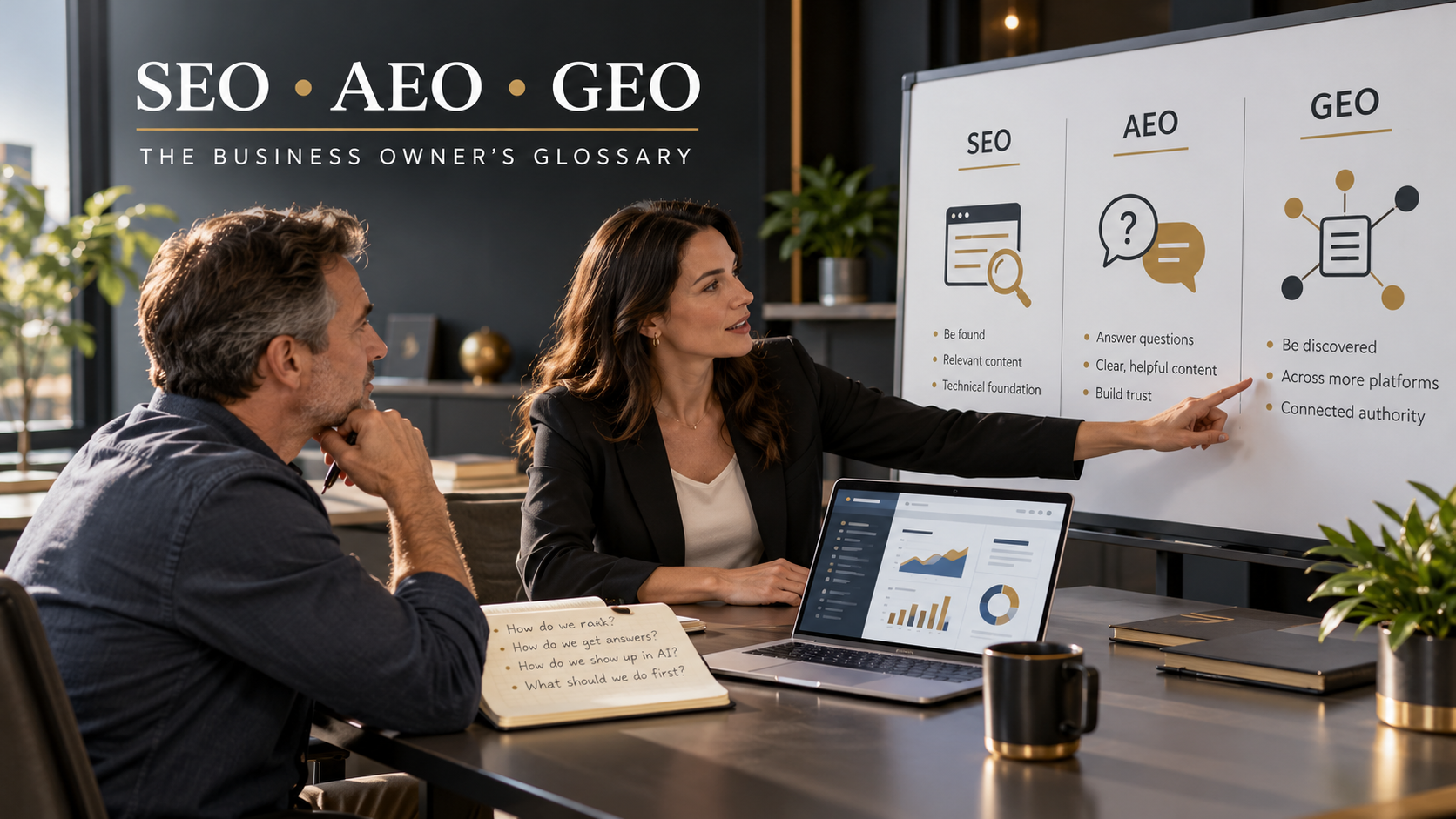
Quick Answer: SEO means search engine optimization, the work of making a website easier for search engines to discover, understand and present to relevant users. AEO means answer engine optimization, a term for making information useful and clear when people ask questions through search or digital assistants. GEO means generative engine optimization, a term used for improving how a business’s information may be discovered and represented in AI-generated responses. These are related approaches, not three separate systems that guarantee rankings, recommendations or sales.
How to Use This SEO Glossary Without Becoming a Marketing Expert
When I discuss marketing with a business owner, I don’t expect that person to understand every technical term. I do expect the provider to explain what the proposed work is supposed to accomplish.
This distinction matters because marketing terminology sometimes makes ordinary tasks sound more complicated than they are.
For example, improving a website’s navigation helps visitors reach relevant information. Updating inaccurate business details reduces confusion. Publishing a clear service description helps prospective customers decide whether to inquire. Those actions may support search visibility, but they also improve the customer experience.
A helpful way to evaluate any unfamiliar term is to ask:
What does it mean? Request a clear explanation without abbreviations.
Why does it matter to my business? Connect the work to a real customer need.
What will actually change? Identify the website page, business listing or process being improved.
How will we evaluate the result? Choose measurements appropriate to the objective.
Those questions help owners participate confidently in decisions without having to manage every technical detail themselves.
SEO Glossary: What Search Engine Optimization Really Means
SEO — Search Engine Optimization
SEO is the process of improving a website so search engines can discover, understand and present its pages to people searching for relevant information.
It includes technical website work, useful content, clear navigation and other factors that support search visibility.
Google’s Search Central documentation explains that SEO helps search engines understand content while helping users find a website and decide whether it is useful.
For a business owner, the practical goal is not simply to appear for a large number of phrases. It is to become more visible when suitable customers are looking for relevant services.
Our search engine optimization services address those foundational requirements.
Organic search
Organic search refers to the unpaid search listings that appear when someone uses a search engine.
A business does not pay the search engine for each click on a traditional organic result. However, building and maintaining an effective website can still involve investment in content, development and professional services.
Organic visibility is different from paid advertising, where placements are associated with advertising campaigns.
Ranking
A ranking is a page’s position in a particular set of search results.
Rankings can vary by query, location, device, language and search experience. A provider who says a business is ranked first should explain which query was checked, under what conditions and whether the result is consistent.
A strong ranking for an irrelevant phrase may produce little business value.
Keyword and focus keyword
A keyword is a word or phrase associated with what someone searches for.
A focus keyword is the primary phrase a publisher chooses to emphasize for a particular page. Tools such as Rank Math use that selection to perform content checks.
The focus keyword is an editorial planning choice, not a guarantee that Google will rank the page for that expression.
Search intent
Search intent means what someone is trying to accomplish with a search.
A person researching the advantages of a particular treatment has different needs from someone ready to request a consultation. Likewise, a traveler comparing airport transportation options may not yet be ready to reserve a car.
Useful pages respond to the customer’s likely purpose rather than simply repeating a keyword.
AEO: What Answer Engine Optimization Means
AEO — Answer Engine Optimization
AEO is an industry term for making content easier to understand and use when people ask specific questions through search systems, digital assistants or conversational interfaces.
It is closely related to creating clear, helpful content. It should not be confused with a guaranteed method of controlling which website a system selects as its answer.
Our answer engine optimization services focus on explaining relevant information clearly for people and search-driven experiences.
Featured snippets and direct answers
A featured snippet is a search feature that may highlight part of a page to answer a query. A direct answer is a broader description of information supplied within a search experience.
Website owners cannot purchase or guarantee ordinary featured-snippet selection through an agency.
Clear definitions, descriptive headings and well-organized explanations may make information easier to interpret, but eligibility and presentation remain decisions of the search provider.
Question-based content
Question-based content addresses concerns in the language customers naturally use.
For example, someone considering a limousine reservation might ask how airport pickups are coordinated. A business website can answer that question accurately and explain what the company’s actual service includes.
Effective question-based content gives the answer first and adds necessary context afterward. It should not promise services the business cannot deliver.
GEO: What Generative Engine Optimization Means
GEO — Generative Engine Optimization
GEO is a marketing term for work intended to improve how information about a business may be discovered, understood or referenced within generative AI experiences.
Unlike traditional search listings, some AI interfaces combine information from different sources into a response. Their behavior can vary by provider, question, model and available evidence.
The purpose of GEO should be to make accurate, useful business information easier to evaluate. It is not a special switch that forces AI systems to recommend a company.
Eagles Media Enterprises offers generative engine optimization services as part of a broader digital visibility strategy.
AI Overviews
AI Overviews are AI-generated summaries that can appear in Google Search when Google’s systems determine that a summary would be useful.
They may contain links to supporting sources and can change depending on the question.
Google states in its official documentation that its established SEO practices remain relevant to AI Overviews and AI Mode. It does not require a special AI-only markup format for a page to be eligible.
AI citations and mentions
An AI citation is a link or reference associated with information used in an AI response.
An AI mention is an appearance of a business, product or organization in generated text.
A mention does not necessarily lead to a website visit. A citation does not establish that the business has gained a customer. Neither can be guaranteed consistently across all platforms or questions.
Owners should be cautious when agencies present isolated screenshots of AI recommendations as proof of dependable business growth.
SEO, AEO and GEO: Understanding the Difference
These approaches overlap considerably.
SEO focuses on helping websites become discoverable and useful through search engines. AEO emphasizes clear answers to relevant questions. GEO focuses on how business information may appear in generative AI experiences.
They should not be treated as three unrelated packages that every company must purchase.
A well-maintained website with accurate service descriptions, useful answers and reliable technical foundations may support all three objectives.
Consider a local medical spa. Its website should explain legitimate services, identify appropriate professional information and provide a way to request a consultation. Those same explanations may be helpful to people using conventional search, question-based tools or conversational AI.
The fundamentals remain connected.
In my view, the priority is to create information that accurately represents a real business. New discovery technologies may change the way that information is presented, but they do not eliminate the need for trust and usefulness.
Technical SEO Terms Every Business Owner Should Recognize
Technical terms can be intimidating because they describe processes happening behind the website.
Owners usually do not need to implement them personally. They should understand enough to ask whether important pages can be accessed, maintained and evaluated properly.
Crawling
Crawling is the process by which a search engine’s automated systems discover and request web pages.
A page cannot reliably participate in ordinary search discovery if the relevant system cannot access it.
Indexing
Indexing is the process of evaluating and storing information about a page so it may become eligible for search results.
Being indexed does not guarantee high rankings or even that a page will appear for a particular search.
XML sitemap
An XML sitemap is a file that helps search engines discover URLs a website owner considers important.
It is useful for site management but does not guarantee that listed pages will be indexed.
Robots.txt
A robots.txt file provides crawling instructions to compliant automated crawlers.
It is not a reliable method of protecting confidential information. Private material should be secured appropriately rather than merely listed as disallowed to crawlers.
Canonical URL
A canonical URL is the preferred version of a page when similar or duplicate URLs exist.
It helps search systems understand which version should generally represent the content. Canonical signals are not absolute commands in every circumstance.
Redirect
A redirect sends visitors and automated systems from one URL to another.
A permanent redirect can be appropriate when a page genuinely moves to a replacement. Redirecting unrelated deleted pages to the homepage simply to eliminate error reports can create confusion.
Page speed and website performance
Page speed describes how quickly a website responds and becomes usable.
A slow site may frustrate visitors, particularly on mobile devices. Owners should assess speed alongside accessibility, stability and whether visitors can complete important actions.
Reliable website hosting and regular website maintenance support these operational requirements.
SEO Glossary: Understanding Content, Structure and Website Experience
A website needs more than technical accessibility. Its content must help the intended audience understand what the business offers.
This is where owners often encounter terminology concerning page structure, titles and writing.
H1 and H2 headings
An H1 generally identifies the main topic of a page. H2 headings organize major sections beneath it.
Well-structured headings help readers navigate information. They also provide context for search systems.
A good heading describes the subject clearly. Repeating an awkward phrase simply to satisfy an editing tool does not necessarily make the page more useful.
SEO title and meta description
The SEO title is the title supplied for search engines through the page’s title element. Search systems may generate a different displayed title depending on the query.
A meta description is a short summary that may be used in search results. Google can instead select a different excerpt when it considers that more relevant.
Neither field guarantees a particular ranking or click-through rate.
Internal links
Internal links connect pages within the same website.
They help visitors move from general information to more detailed, relevant explanations. They also help search systems discover related pages.
Good internal links are chosen because the destination is genuinely useful—not because an article must reach an arbitrary link count.
Anchor text
Anchor text is the clickable wording associated with a link.
Descriptive wording helps readers understand where the link leads. Repeated, unnatural keyword phrases can make an article harder to read.
Helpful content
Helpful content serves a real purpose for the intended reader.
For a professional services company, that may mean explaining a process, setting expectations or answering questions that influence a decision.
Our content writing services focus on developing information that matches business services and customer needs.
A useful SEO glossary should help owners recognize the difference between meaningful explanations and content written only to repeat search phrases.
Local SEO and Google Business Profile Terms
Local visibility matters for businesses that serve customers in particular geographic areas.
A clinic, contractor or transportation company may depend heavily on people searching for services in or near the locations it actually serves.
Local SEO
Local SEO concerns improving a business’s online presence for searches with local relevance.
It may involve accurate business information, suitable website pages, appropriate service areas and reputation management.
Google Business Profile
A Google Business Profile is a business listing that eligible organizations can manage on Google Search and Maps.
Owners should maintain accurate information about their operation and follow the applicable eligibility rules.
Professional Google Business Profile management can support this work, but a provider cannot guarantee that Google will display a business for every desired query.
NAP
NAP stands for name, address and phone number.
The term describes core business contact details that should be represented consistently and accurately.
Not every service-area business should display a residential or private operating address publicly. Business owners should follow platform rules about eligible locations and address visibility.
Local pack
The local pack is a group of business results that may appear for geographically relevant searches.
Its appearance and contents can vary depending on the search, location and other circumstances.
Service-area business
A service-area business serves customers at their locations rather than necessarily receiving customers at a public storefront.
Eligibility for particular business listing features depends on the platform’s rules and the business’s actual operation.
These distinctions are particularly important for mobile service providers, contractors and certain transportation businesses.
Understanding Website Visitors, Conversions and Sales
One of the biggest sources of confusion in marketing reports is the difference between website activity and business results.
More traffic is not necessarily more revenue.
A business may receive thousands of visits but very few suitable inquiries. Another may attract fewer visitors and produce more profitable appointments.
Owners need to understand which actions matter.
Traffic
Traffic is the activity of people visiting a website, generally measured through sessions, users or related analytics metrics.
Different analytics systems define these measurements differently.
Traffic should be interpreted alongside the purpose of the website.
Conversion
A conversion is an action that a business chooses to measure as valuable.
Examples include submitting an inquiry, booking an appointment or completing a purchase.
A form submission is not automatically a sale. Owners should distinguish preliminary actions from completed business outcomes.
Conversion rate
Conversion rate generally describes the proportion of measured visits or users who complete a defined action.
The calculation depends on the reporting system and selected conversion event.
An agency should explain exactly which action it counts.
CTA — Call to Action
A call to action is the prompt encouraging a visitor to take the next appropriate step.
Examples include requesting an estimate, scheduling a consultation or contacting the office.
Effective calls to action are clear and supported by accurate surrounding information.
UX — User Experience
User experience describes how a person interacts with a website or digital service.
Clear navigation, understandable forms, mobile usability and accessible information all contribute.
Professional website design should support these practical needs, not focus exclusively on appearance.
CRO — Conversion Rate Optimization
Conversion rate optimization refers to improving how successfully a website supports defined customer actions.
For example, simplifying a confusing appointment form may reduce abandonment. Any improvement should be evaluated using actual results rather than assumptions.
PPC, Paid Advertising and Other Marketing Terms
Business owners often hear SEO and PPC discussed together, even though they represent different ways of reaching potential customers.
PPC — Pay Per Click
PPC is an advertising model in which the advertiser pays when someone clicks an advertisement.
It is commonly associated with search advertising, although different platforms may use additional billing models.
Our PPC advertising services address paid campaigns intended to reach suitable audiences.
CPC — Cost Per Click
CPC is the amount paid for an advertising click.
A low cost per click does not necessarily mean a campaign is successful. The visitors must still be relevant to the business.
CPA — Cost Per Acquisition
CPA describes the cost associated with acquiring a defined result, such as a lead or customer, depending on how the campaign is configured.
An agency should explain which acquisition event is being measured.
ROI and ROAS
ROI means return on investment. It considers the financial return relative to an investment using an identified calculation.
ROAS means return on advertising spend and generally compares attributed advertising revenue with advertising costs.
ROAS does not automatically account for every operating expense, so a positive advertising return may not establish overall profitability.
Social media engagement
Engagement can include reactions, comments, shares and other interactions with social content.
Those signals may support awareness, but they do not automatically demonstrate new customers or sales.
Professional social media management should consider how activity contributes to the company’s objectives.
E-Commerce SEO Terms for Online Stores
Online retailers encounter additional terminology related to products, categories and purchasing.
These concepts matter because an online store must help customers both find relevant products and complete transactions.
Product page
A product page presents information about a specific item, usually including descriptions, availability and appropriate purchasing details.
Information should accurately represent the item offered.
Category page
A category page organizes a related group of products so visitors can compare available choices.
Useful categories make navigation easier and reduce the need to search through unrelated inventory.
Product structured data
Product structured data is machine-readable information that can help eligible search systems interpret details about products and offers.
It must accurately reflect the visible page content and follow applicable platform guidelines.
Adding markup does not guarantee enhanced search displays.
Cart abandonment
Cart abandonment occurs when someone adds items to an online shopping cart but does not complete checkout.
Potential causes include unexpected costs, payment difficulties, delivery concerns or a complicated purchasing process.
Appropriate e-commerce website development considers both product discovery and the customer experience through checkout.
Trust, Authority, Backlinks and E-E-A-T
Some of the most frequently misunderstood marketing terms concern trust and authority.
A provider may claim to increase a company’s authority score or guarantee higher rankings through backlinks. Owners should understand what these statements actually mean.
Backlink
A backlink is a link from another website to yours.
Links can help people discover information and may contribute to how search systems understand websites.
However, buying manipulative links or creating artificial link networks can violate search engine spam policies.
Authority Score
Authority Score is a proprietary metric used by certain third-party marketing tools.
It can be useful for comparisons within a tool’s methodology, but it is not an official Google ranking score.
An increase in a third-party metric does not establish that customer inquiries or revenue will increase.
E-E-A-T
E-E-A-T stands for Experience, Expertise, Authoritativeness and Trustworthiness.
Google uses the concept in its search quality evaluation framework to help explain qualities associated with useful, reliable information.
It is not a single numerical website score that an agency can directly set.
Brand mentions
A brand mention occurs when a company or product is discussed online, with or without a link.
Mentions may contribute to public awareness, but their effects on search or AI recommendations should not be exaggerated.
The most credible brand information comes from real services, accurate descriptions, genuine customer experiences and legitimate recognition.
Practical Examples: How the Terms Work Together
The value of this SEO glossary becomes clearer when we apply the definitions to real business situations.
Consider a limousine company looking for more airport reservations. Its website needs accurate transportation service information, properly functioning booking forms and a way for passengers to understand pickup arrangements. Search visibility can help people discover the company, while clear answers reduce hesitation before a reservation.
That is why limo and black car company digital services should connect online visibility with actual inquiries and bookings.
Now consider a medical spa. Prospective clients may want to understand treatment options, provider qualifications and the consultation process. Useful information must be accurate and sensitive to healthcare advertising requirements.
Appropriate med spa website and search services should support those needs rather than promise specific medical outcomes.
In both examples, traditional search, clear answers and newer AI discovery experiences draw on the same underlying business information. No separate buzzword replaces the need to represent the business honestly.
Common SEO and AI Marketing Claims Owners Should Question
A provider may present a long list of technical services as evidence that a campaign is comprehensive. That list becomes meaningful only when the business understands what will happen.
Before approving a proposal, look carefully at claims such as:
“Guaranteed first-page rankings.” Search placement depends on systems an outside agency does not control.
“Guaranteed AI recommendations.” AI responses vary, and no agency can ensure a business appears in every relevant answer.
“Instant authority increases.” A third-party metric may change without reflecting real customer growth.
“Hundreds of pages automatically create traffic.” Large quantities of repetitive or low-value content can create quality and duplication problems.
“Special AI files guarantee visibility.” Google does not require an AI-specific file or special schema to qualify for its AI search features.
“Every website needs all three packages.” SEO, AEO and GEO overlap, and the work should reflect actual business needs.
The strongest proposals explain priorities, deliverables, responsibilities, realistic measurement and limitations.
A responsible provider should also identify when the website or customer-contact process is preventing inquiries from turning into business.
A Simple Plan for Business Owners
Once you understand the terminology, the next task is to use it to make practical decisions.
First, identify the business outcome. Decide whether the immediate need is qualified calls, appointment requests, reservations, product sales or repeat business.
Second, verify the foundations. Check that the website is accessible, important pages work, business contact information is correct and customers can reach the company.
Third, improve useful information. Explain services honestly, answer common questions and make relevant next steps clear.
Fourth, measure meaningful results. Distinguish impressions from visitors, visitors from inquiries and inquiries from completed business.
Fifth, review your provider’s recommendations. Ask which problem each proposed improvement addresses, why it is a priority and how results will be evaluated.
Owners can review our broader digital marketing services to see how different capabilities fit together. They can also learn more about Eagles Media Enterprises and its business focus before deciding whether a provider’s experience matches their needs.
A marketing strategy does not become better simply because it uses more acronyms.
Frequently Asked Questions About SEO, AEO and GEO
1. What is the difference between SEO, AEO and GEO?
SEO concerns search engine visibility and website usefulness. AEO emphasizes answering questions clearly through search and assistant experiences. GEO is a term used for improving how information may be discovered or represented within generative AI responses. These approaches overlap and should be planned together.
2. Does a small business need all three services?
Not necessarily as separate purchases. A small business may benefit most from correcting its website, publishing accurate information and improving basic customer contact processes. More specialized work should follow the business’s needs, available resources and measurable objectives.
3. Is traditional SEO still relevant with AI search?
Yes. Google states that established SEO practices remain important for its AI search features. Useful content, accessible pages, appropriate internal links and accurate business details continue to matter. AI interfaces introduce additional discovery experiences rather than eliminating the foundations of search.
4. Can an agency guarantee my business will appear in ChatGPT or Google AI?
No. Independent AI and search products decide how to generate responses and which sources to present. An agency can improve the quality, accessibility and accuracy of business information, but cannot guarantee recommendations for every question.
5. What does an SEO glossary help a business owner understand?
It explains the terminology used in marketing reports and proposals. Owners can use these definitions to ask better questions, compare recommendations and distinguish website activity from genuine business results.
6. What is the difference between website traffic and conversions?
Traffic measures website activity, while conversions describe defined actions such as inquiries, bookings or purchases. A business should determine which conversions have practical value and avoid treating every page visit as a customer.
7. Does a high Authority Score guarantee high Google rankings?
No. Authority Score is a third-party tool metric, not an official Google ranking score. Owners should evaluate actual search performance, relevant inquiries, business outcomes and the quality of the work performed.
8. What does a focus keyword do in Rank Math?
It tells the plugin which phrase to use for its content checks. The plugin can highlight potential optimization issues, but its score does not guarantee search rankings. Content should remain accurate, natural and useful to readers.
9. Do businesses need special schema for AI Overviews?
Google does not require special AI-specific schema markup to be eligible for AI Overviews or AI Mode. Structured data can help eligible systems understand certain page information, but it must follow applicable guidelines and match visible content.
10. Are FAQs still useful if Google no longer shows FAQ rich results?
Yes. Clear questions and answers can help visitors understand important information. Google discontinued its FAQ rich-result feature, but useful FAQ content can still serve readers. Owners should not add FAQ markup merely expecting a special search display.
11. Which marketing measurements should a business owner review?
The most useful measurements depend on the business. Qualified inquiries, appointments attended, confirmed bookings, completed purchases, acquisition costs and revenue may be more meaningful than impressions alone. Ask every provider to define its reported metrics.
12. How should I choose an SEO or AI marketing agency?
Choose a provider that explains its work clearly, understands your business, gives realistic expectations and distinguishes measurable results from promises. Request specific deliverables, a practical reporting approach and a clear explanation of what the company can and cannot control.
Understand the Language, Then Make Better Marketing Decisions
The most important lesson in this SEO glossary is that owners do not need more complicated vocabulary. They need better explanations and accountable decisions.
SEO, AEO and GEO describe related approaches to helping people find and understand information. Technical improvements make websites easier to access and maintain. Useful content helps customers evaluate services. Clear booking and contact processes turn genuine interest into opportunities.
A successful marketing discussion should connect those activities with what the business actually wants to accomplish.
At Eagles Media Enterprises, we believe owners deserve to understand the services they’re purchasing, the work being performed and the limitations of any proposed campaign.
If you have questions about a marketing proposal, a confusing performance report or the practical differences between search and AI visibility, contact Eagles Media Enterprises or call (708) 526-8484 to discuss your business goals.
Address: 400 Ravinia Place, Suite B, Orland Park, IL 60462
Phone: (708) 526-8484