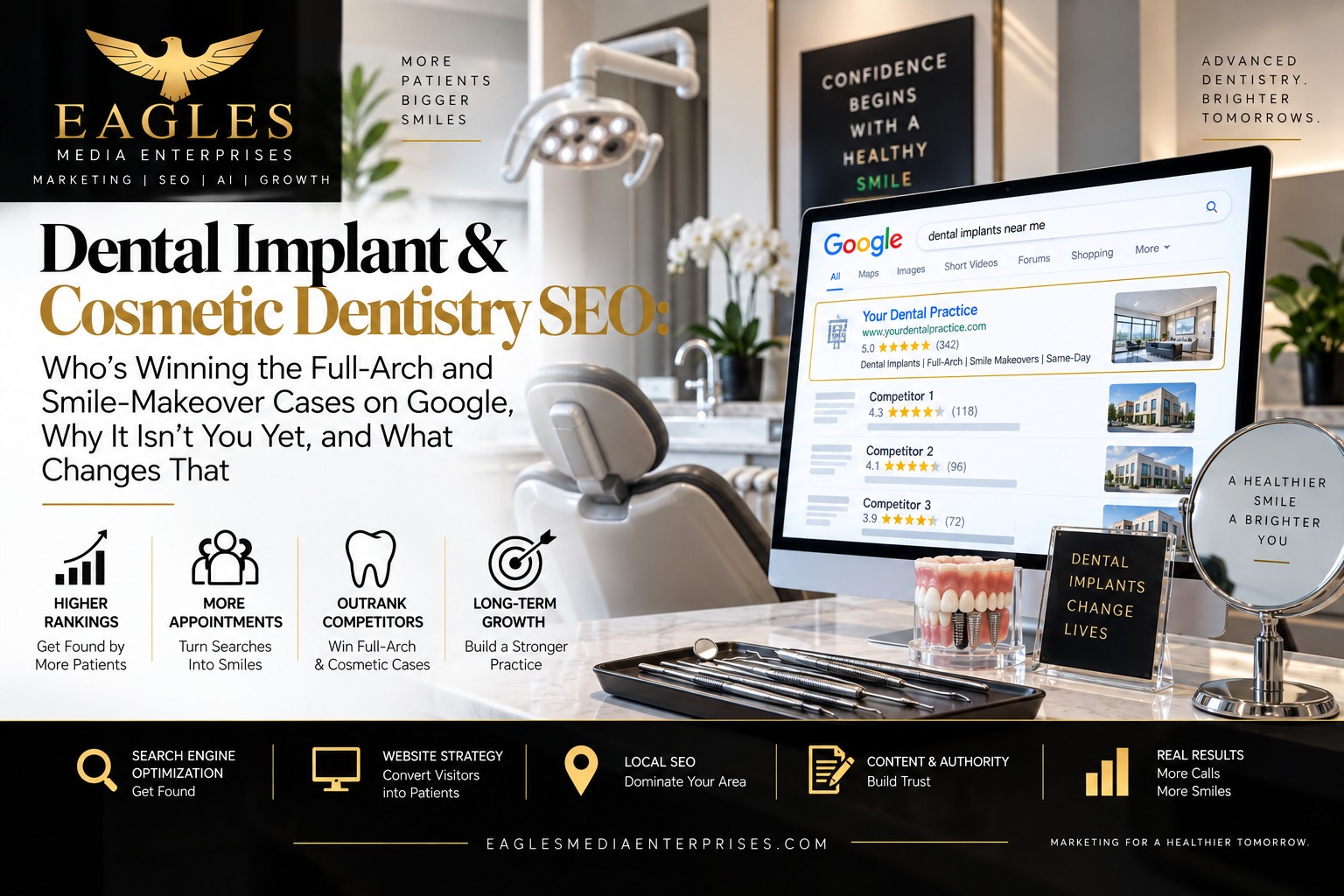
Dental Implant & Cosmetic Dentistry SEO: Who’s Winning the Full-Arch and Smile-Makeover Cases on Google, Why It Isn’t You Yet, and What Changes That
Written by Ibrahim Bazed, CEO of Eagles Media Enterprises
A general dental practice lives on hygiene visits and crowns. A practice that places implants and does cosmetic work lives on a different arithmetic: a handful of full-arch cases and smile makeovers a month change the year. And the patient who wants that work does not walk in off the street — she searches. “Dental implants near me.” “All-on-4 [city].” “Cosmetic dentist [town].” “Veneers cost.” She reads for weeks, compares four practices, and calls one. Right now, in your market, that call is going to a practice that may place fewer implants than you do and simply shows up better. We’ve spent years building search programs for dental practices, and the implant and cosmetic layer is where the return is largest and the competition is most beatable. This is how those cases are won online — and if you would rather see it for your own practice, call (708) 526-8484 and we’ll put it in writing, free.
Quick Answer: Dental implant SEO and cosmetic dentistry SEO are about winning the small number of searches that produce large cases — implants, All-on-4 and full-arch, veneers, smile makeovers, Invisalign for adults — in the practice’s own metro. The practices winning them have a dedicated, substantial page for each procedure, a Google Business Profile built for the doctor as well as the practice, with patient reviews that mention the procedure by name, real before-and-after galleries and real credentials on the page, a consultation path that works on a phone, and a monthly program that keeps all of it ahead of the practice down the road. That program, built and managed by Eagles Media Enterprises for implant and cosmetic practices, is measured in consultations booked rather than rankings: (708) 526-8484.
The Searches That Produce the Cases
Most dental marketing chases “dentist near me,” a search made by someone who needs a cleaning. The implant and cosmetic patient types something else entirely, and there are only a few dozen versions of it in any metro: the procedure plus the city, the procedure plus “near me,” the procedure plus “cost,” the brand-name versions (All-on-4, Invisalign, Zirconia), the comparison (“implants vs. dentures,” “veneers vs. bonding”), and the fear questions (“does dental implant surgery hurt,” “how long do implants last”). Those searches are fewer than the hygiene searches and worth many times more, and in most markets they are held by two or three practices and a dental-service organization with a corporate site. We show a practice exactly who holds each one in its metro on the first page of the review — and which ones are winnable inside a quarter.
Why the Practice Down the Road Is Getting Your Implant Patients
It is rarely the clinical work. The practice winning implant and cosmetic searches has, almost always, done four things yours hasn’t. It has a real page for each procedure — not a “Services” list with “Implants” as a bullet — written the way the doctor explains the case at the consult: who’s a candidate, what the process is, how many visits, what recovery looks like, what affects the fee, what the alternatives are, and what the patient’s own questions are. It has the doctor’s name, face, training, and implant credentials on that page, because the patient choosing surgery is choosing a surgeon. It has a Google Business Profile that names the procedures in its services and collects reviews that say “implant” and “veneers” in the patient’s words, month after month. And it has a before-and-after gallery of its own patients, with the doctor’s consent process behind it, rather than stock smiles. There’s no mystery in any of it — only hours a practice owner can’t spare, which is precisely the work we take on.
The Profile Layer Most Practices Miss
On local searches the map decides who gets the call, and dental practices have a specific advantage they rarely use: Google permits one listing for the practice plus a separate listing for every practitioner. An implant dentist with a properly built practitioner listing — correct category, the procedures listed, reviews attached — can appear in the map for “implant dentist [city]” where the practice profile alone would not. Most practices have a practitioner listing that was auto-created years ago, unclaimed, with a wrong address and no reviews, quietly competing with the practice itself. Correcting that is one of the first things we do, and it is often the fastest movement a practice sees. Our Google Business Profile guide for dentists explains the structure; our Google Business Profile management service runs it every month.
Proof the Implant Patient Is Looking For
A patient about to spend on a full arch or a smile makeover is not comparing prices first; she is deciding whether to trust a surgeon she has never met. The page has to answer that before it answers anything else: the doctor’s training and years placing implants, the implant systems used, the technology in the office, the professional memberships, the real reviews with real names describing the same procedure, the gallery, and a plain description of what the first consultation involves. Google reads the same signals — a named expert with visible credentials stating clear answers is what its guidelines reward and what its AI summaries now cite. A practice site that hides the doctor behind a logo loses the patient and the ranking at the same time.
Where the Consultation Is Lost
A practice can rank for “dental implants [city],” draw the patient to the page, and lose her at the last step: an appointment request that demands nine fields, no online scheduling, a phone number that isn’t tappable, or a front desk that answers “Doctor’s office, please hold.” We track the whole path — the search, the page, the tap, the call, the recording, the consult booked — because a ranking that doesn’t become a consultation is a number, not a case. The website side of that is the subject of our dental website design guide; the front-desk side gets its own conversation during onboarding, and it’s routinely the least expensive fix with the biggest payoff.
What We Do for Implant and Cosmetic Practices
It opens with a written assessment of the practice’s standing on every implant and cosmetic search in its metro — who holds each one, whether the practice and practitioner profiles are helping or hurting, what the procedure pages are missing, where the consultation path breaks, and whatever an earlier marketing vendor left in place — sent within two business days, at no cost, with nothing to sign. From there the program builds the procedure pages, rebuilds both profile layers, installs the proof and the gallery, fixes the consultation path, and then runs the monthly rhythm of reviews, content, and links from the dental associations, study clubs, and referring practices the doctor already knows. Reporting is in consultations booked by source. The general dental program is described on our dental SEO services page and in the SEO for dentists guide; practices with several offices get the structure in our multi-location dental SEO guide; the implant and cosmetic layer sits on top of all of it.
What the Practices That Win Have in Common
They treat the implant patient’s search as a separate business from the hygiene patient’s search, with its own pages, its own reviews, and its own measurement. They put the doctor on the page. They answer the fee question honestly enough that the patient stays — a range, what drives it, and what financing looks like — without publishing a price list. They keep the rhythm: a new case in the gallery each month, a review request after every seated case, a procedure page refreshed annually at its existing URL so the ranking keeps building. And they stopped paying a national dental-marketing company for a template site identical to four hundred others. The results we’ve seen — practices entering the map for their own suburb, consultations arriving from searches they had never appeared for — are described by the doctors themselves on our customer reviews page.
Questions Practice Owners Ask Before They Call
We’re a general practice that places implants. Is this for us?
Yes — the implant and cosmetic layer sits on top of the general program. A practice that places even a few implants a month has cases worth winning.
Do we have to publish our fees?
No. The page has to answer the fee question well enough that the patient books the consult; that’s a range and an explanation, not a price list.
We used a national dental marketing company. Why didn’t it work?
Usually a template site shared with hundreds of practices, generic pages, and a profile nobody managed. The review will show you exactly what they left behind.
How long until implant consultations move?
Profile corrections and reviews tend to shift the map inside a few weeks; new procedure pages start taking specific searches over the next one to three months; the hardest phrases need more. Your metro’s timeline is part of the review.
What happens when we call?
A short conversation about the practice, the procedures, and the consultations you want more of; then the written review, then a proposal only when you request it.
The Cases Are Being Searched For Right Now
Somewhere in your metro tonight, a patient is reading about full-arch implants and deciding which practice to call in the morning. She should be calling yours. Call Eagles Media Enterprises at (708) 526-8484 or use our contact page, and two business days later you’ll be reading a written review of who holds the implant and cosmetic searches in your market and how your practice takes them. Every part of the program is described under SEO services. Reach out to us for a quote at Eagles Media Enterprises — name the practice, the procedures, and the town, and you’ll receive the plan in writing with the investment spelled out. We own businesses ourselves, and we treat a practice’s growth the way we treat our own.
About the author: Ibrahim Bazed is the CEO of Eagles Media Enterprises in Orland Park, Illinois, where the dental client roster spans general, implant, cosmetic, and multi-office practices in markets across the country.