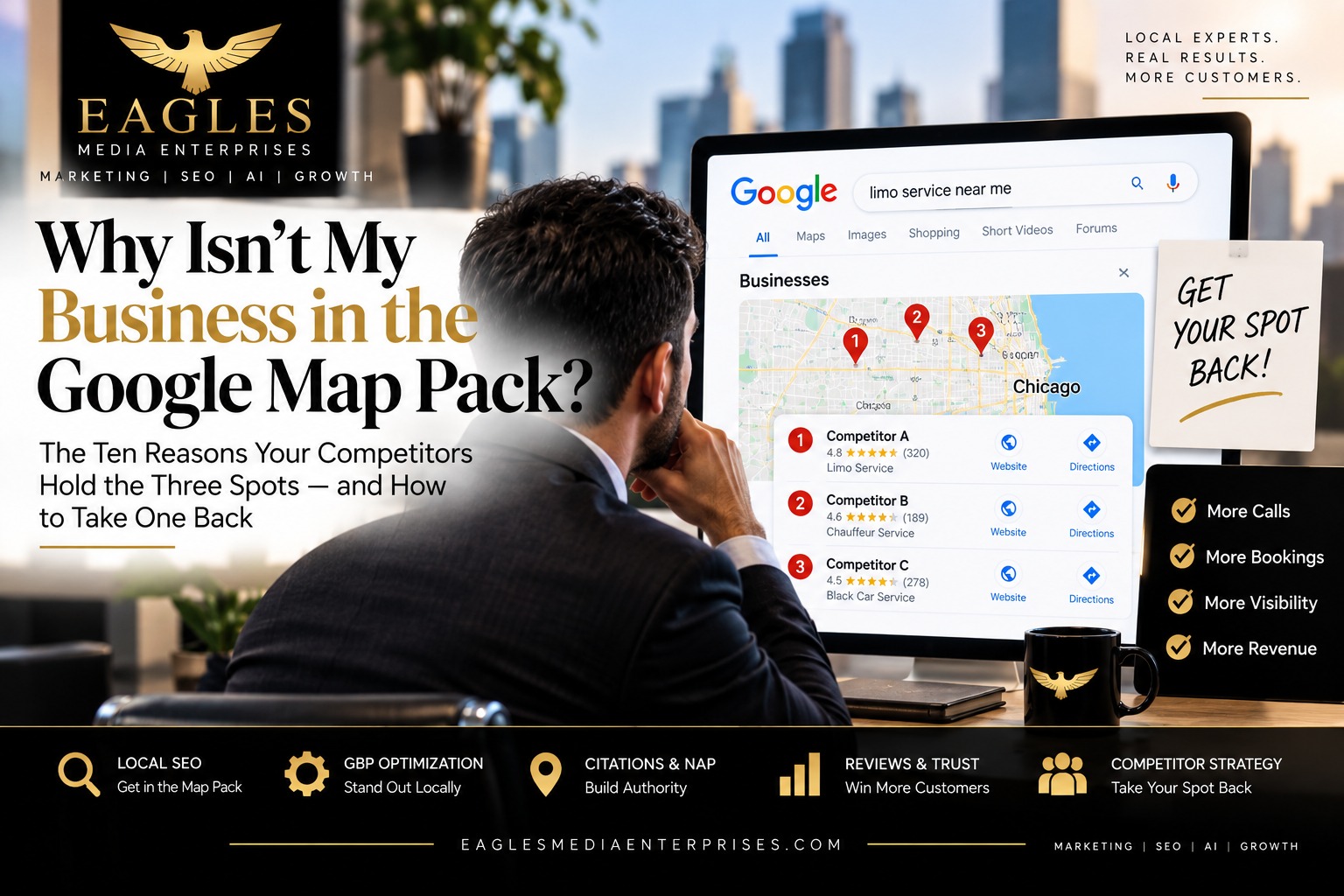
Why Isn’t My Business in the Google Map Pack? The Ten Reasons Your Competitors Hold the Three Spots — and How to Take One Back
Written by Ibrahim Bazed, CEO of Eagles Media Enterprises
The three businesses in the map at the top of a Google search get the phone calls. Everyone below the map gets what’s left. If you have watched a competitor with worse reviews, a smaller shop, and a website from 2014 sit in that box for a year while your business is nowhere in it, you already know the map isn’t ranking the best company — it’s ranking the best-configured profile. That is good news, because a configuration can be fixed. Here are the ten reasons a business doesn’t make the map pack, how to tell which ones apply to you, and what to do about each. Most of them cost nothing but attention.
Quick Answer: Google fills the map pack using three things it names openly — relevance, distance, and prominence — and a business is missing from it for one of ten reasons: the searcher is too far from your address, your primary category is wrong or too broad, the profile is incomplete or unverified, your name, address, and phone don’t match across the web, you have too few recent reviews or you never answer them, the website page the profile links to says nothing about the service, competitors are cheating with keyword-stuffed names or fake listings you haven’t reported, you have duplicate or old listings splitting your signals, the profile is suspended or flagged, or the search you’re testing is one you can’t win from where you sit. Eagles Media Enterprises diagnoses all ten in a free written review: (708) 526-8484.
First, Understand What the Map Pack Actually Ranks
The map is not a ranking of websites. It is a ranking of Google Business Profiles, and Google says in its own help pages that it orders them by relevance (does the profile match the search), distance (how far the business is from the person searching, not from the city center), and prominence (how well known the business is — reviews, mentions, links, and how much Google trusts the information). Every reason below is a failure in one of those three columns. Once you know which column is weak, the fix is obvious.
Reason 1: You’re Testing From the Wrong Place
Owners search from their own desk, see the map, and don’t see themselves. But Google builds the map around the searcher’s location to within a few blocks, so the map you see at your shop is not the map a customer sees three miles away — and the reverse. Before anything else, check the map from the neighborhoods your customers actually live in (a rank-tracking tool does this on a grid; we run one for every local client). Many businesses that “aren’t in the map” are in it for a two-mile circle and invisible beyond it. That is a proximity problem, and the rest of this list is how you widen the circle.
Reason 2: The Wrong Primary Category
The primary category is the single strongest relevance signal on the profile, and it is wrong more often than not. A med spa listed as “Beauty salon,” a limousine company listed as “Transportation service,” a dentist listed as “Doctor,” a roofer listed as “Contractor” — each one is telling Google to show the business for searches it doesn’t want and hide it from the ones it does. The fix: set the primary category to the most specific option that describes what most of your revenue comes from (“Medical spa,” “Limousine service,” “Dentist,” “Roofing contractor”), then add secondary categories for the rest. Check what the three businesses in the pack use — the category is visible on their profiles — and match the one that wins.
Reason 3: The Profile Is Half-Finished or Never Verified
An unverified profile does not rank. A verified one with no hours, no services, no description, two photos, and no posts ranks like it’s half-open. Google measures completeness, and it rewards a profile that is updated the way a storefront is. The fix: verify (video verification is now the norm; keep the signage and the vehicles ready to show), fill every field — services with descriptions and prices, hours including holidays, attributes, the booking link, a description that says what you do and where — and add photos every month and a post every week. This is the routine our Google Business Profile management service runs for clients, and it is the reason their profiles keep climbing while dormant competitors drift.
Reason 4: Your Name, Address & Phone Don’t Match Across the Web
Google confirms your business by checking the same three facts — name, address, phone — on Yelp, Facebook, the Better Business Bureau, the chamber, industry directories, and dozens of data aggregators. If the suite number appears on some and not others, an old phone number lingers on a directory from 2019, or the business name is written three different ways, Google’s confidence in the listing drops and prominence drops with it. The fix: pick one exact format and correct every listing to it. Our citations and NAP consistency post walks through it for dental offices; the method is identical for any business.
Reason 5: Too Few Reviews, Too Old, or Never Answered
Reviews are the loudest prominence signal a small business controls. Google weighs the count, the average, how recent they are, whether they mention the services you sell, and whether the owner replies. A profile with 40 reviews that stopped arriving in 2023 loses to a profile with 60 that gets three a week. The fix is a system, not a wish: ask every satisfied customer at the moment the job ends, make it a one-tap link (the short review link is in your profile), and reply to every review — the good ones with thanks that mention the service, the bad ones with calm and a phone number. Never buy reviews and never ask staff or relatives; Google removes them and can suspend the profile.
Reason 6: The Website Page Behind the Profile Says Nothing
The profile links to a web page, and Google reads that page to decide relevance. If it links to a home page that mentions your service once in a slider, the profile inherits that weakness. The fix: point the profile at the page that best matches the searches you want — usually a service page — and make that page substantial: the service, the city and the neighborhoods, the prices or the price drivers, the questions customers ask, real photos. When a client’s map rankings stall, rewriting that one page is often what breaks the stall; it’s why SEO content writing and profile management are sold together at our office. If the whole website is invisible, not just the map, start with our post on why a website doesn’t show up on Google.
Reason 7: Competitors Are Cheating and Nobody Reported Them
Look closely at the three profiles in the pack. “Joe’s Plumbing” has become “Joe’s Plumbing – Emergency Plumber Orland Park 24/7.” A limo company has four profiles at four virtual offices. A “dentist” listing sits at a UPS Store address. All of it violates Google’s guidelines, all of it works until someone reports it, and most owners never do. The fix: suggest an edit on the offending profile for keyword-stuffed names, and file a Business Redressal Complaint for fake addresses and duplicate locations. It takes fifteen minutes, it is free, and it removes competitors that were never supposed to be above you. We do this on the first day of every local campaign.
Reason 8: Duplicate or Old Listings Are Splitting Your Signals
A profile the previous owner created, a listing from the old address, a second profile a marketing company set up without telling you — each one takes reviews, clicks, and confidence away from the real listing, and Google may suppress both rather than choose. The fix: search Maps for your business name and phone number, claim or request ownership of every duplicate, and mark the extras as duplicates or moved so their history merges into the one you keep.
Reason 9: The Profile Is Suspended, Flagged, or Quietly Restricted
A suspension is announced in the dashboard; a soft restriction is not. A profile whose name was edited to add keywords, whose address was changed twice, whose category flips monthly, or whose reviews arrived in a suspicious burst can be held back with no notice. The fix: open the profile in the dashboard and read every notice; then stop the behavior that triggered it, restore the legal business name, and, if suspended, file the reinstatement request with the documents — the license, the utility bill, the photos of signage — before appealing. Reinstatements are slow and unforgiving of a sloppy first submission, which is why a professional should file it.
Reason 10: You’re Chasing a Search You Can’t Win From Your Address
A business in Tinley Park will not appear in the map for “dentist Chicago” for a searcher in Lincoln Park; distance decides that before anything else does. Owners waste months on a phrase that belongs to businesses located where the searchers are. The fix: win the map for your own radius first — the town, the neighboring towns, the phrases that name your services — then let organic rankings (the results below the map, which are not distance-bound in the same way) carry the wider region. The local SEO vs. SEO post lays out how those two results lists follow different rules, and the affordable local SEO for Google Maps visibility post covers what a lean local campaign looks like.
The One-Hour Self-Check
In order: check the map from three customer neighborhoods, not your desk. Open your profile and confirm verification, the primary category, and every field. Search your phone number in Maps for duplicates. Read your last ten reviews and their dates, and count how many you answered. Open the page the profile links to and count the words about the service. Read the three winning profiles for name-stuffing and fake addresses. That hour tells you which of the ten reasons is yours — and if the answer is “several,” that is normal, and it is what a monthly local campaign is for. The cost of one is in our post on how much local SEO costs monthly.
What It Looks Like When the Map Turns
The business that gets into the pack sees it in the phone log before it sees it in any report: calls from people who never visited the website, direction requests, “are you open now” at 7 a.m. A limousine client of ours whose profiles we rebuilt now takes the majority of its airport bookings from the map rather than from ads — the story is in our Google Business Profile guide for limo and black-car companies, and the broader results are on our customer reviews page. The same mechanics apply to a dentist, a med spa, an HVAC company, or a wholesaler with a showroom.
Map Pack Questions Owners Ask
What’s the timeline for getting into the map pack?
Category, completeness, and duplicate fixes can move a profile within two to six weeks; reviews and citations compound over three to six months. Suspension reinstatements run on Google’s clock, not yours.
I’m a service-area business with no storefront. Can I still rank in the map?
Yes, with the address hidden and service areas set — but distance is still measured from the address on file, so where the business is registered matters.
Do Google Ads help my map ranking?
No. Ads can buy a sponsored pin, but they don’t change where the organic map ranks you, and the pin disappears with the budget.
Should I put keywords in my business name?
No — it works until it’s reported, then it costs you the profile. Use the legal name and put the keywords in categories, services, and the website.
Can you manage the profile for me every month?
That is exactly what we do — posts, photos, review replies, Q&A, spam reporting, and rank tracking on a neighborhood grid, reported to you in plain language.
Three Spots. One of Them Should Be Yours.
The map pack is not reserved for the biggest company in town; it belongs to the business that gives Google the cleanest, most complete, most trusted picture of itself. Eagles Media Enterprises will review your profile against all ten reasons and send the findings in writing, free — call (708) 526-8484 or use our contact page. The complete local and organic program is on our SEO services page. We’re owners too; we know what a ringing phone is worth. Reach out to us for a quote at Eagles Media Enterprises — send the business name and the towns you want to win, and the quote comes back with the map fixes listed in order.
About the author: Ibrahim Bazed is the CEO of Eagles Media Enterprises in Orland Park, Illinois, where he leads local and nationwide search campaigns for service businesses, medical practices, transportation companies, and wholesalers across the United States.